
FTZ vs bonded. Foreign Trade Zones (FTZs) and Customs Bonded Warehouses both offer duty deferral until cargo enters domestic commerce. However, their operational requirements, processing permissions, and total cost footprints differ substantially. Choosing the wrong model locks your operations into unnecessary compliance overhead or leaves significant duty savings unrealized.
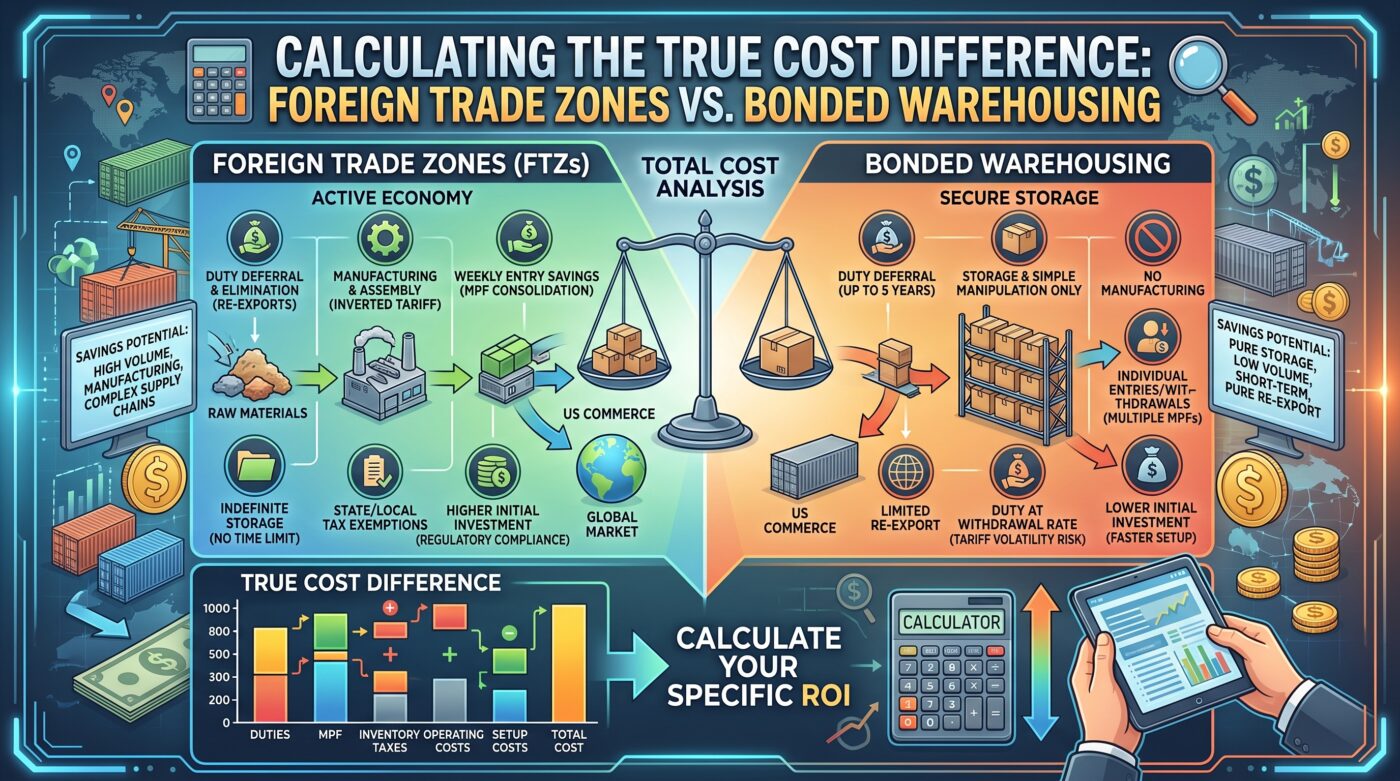
Merchandise Processing Fee (MPF) Consolidation
For companies shipping high container volumes, MPF math frequently dictates the decision. In a bonded warehouse, MPF is assessed on every individual consumption entry filed upon withdrawal (calculated at 0.3464% of entered value, up to the statutory cap).
In contrast, FTZ operators file a single consolidated Weekly Entry under 19 CFR 146.63. Whether your facility processes 5 containers or 100 containers over a seven-day period, your MPF is capped at $614.35 for the entire week. For high-volume operations, this structural cap saves hundreds of thousands of dollars annually, easily offsetting FTZ software and oversight expenses.
Duty Inversion and Manufacturing Permissions
Bonded warehouses operate strictly under 19 U.S.C. 1562, allowing sorting, repacking, or cleaning, but prohibiting assembly or manufacturing.
FTZs allow full industrial manufacturing and assembly operations. This unlocks duty inversion: if imported components carry an 8% duty rate but the assembled finished product carries a 0% duty rate, the importer pays the 0% finished-good tariff when goods leave the zone into U.S. commerce.
Selecting the Right Model
If your cargo requires long-term storage without processing, a Class 2 or Class 3 bonded warehouse minimizes setup expenses. If your operation involves high weekly shipment frequency, manufacturing, or heavy MPF exposure, an FTZ delivers superior long-term margins.
FAQ
Can I convert a bonded warehouse into an FTZ?
Yes. Facilities can transition by applying through the local FTZ grantee and submitting an activation request to CBP, though this requires dedicated inventory control software.
Do FTZs eliminate customs duties completely?
No. FTZs defer duties until merchandise enters U.S. commerce. If goods are re-exported directly from the zone to an international destination, U.S. customs duties are eliminated entirely.
How does FTZ activation affect my customs bond requirements?
Operating an FTZ requires an FTZ Operator Bond (Activity Code 4), which is calculated based on operational scope and inventory value rather than trailing duty payments alone.
Are bonded warehouses subject to local property taxes on inventory?
In most jurisdictions, inventory inside a bonded warehouse remains subject to local ad valorem personal property taxes, whereas foreign inventory in an FTZ is federally exempt.
Can goods subject to Partner Government Agency reviews enter an FTZ?
Yes. FDA, USDA, and EPA-regulated merchandise can be admitted to an FTZ, though PGA admissibility reviews still occur upon zone admission or consumption entry.
Book a Free Consultation Call to run a cost-benefit analysis on your import data. We calculate your MPF savings, evaluate duty inversion potential, and determine whether an FTZ or bonded warehouse minimizes your overall landed costs.