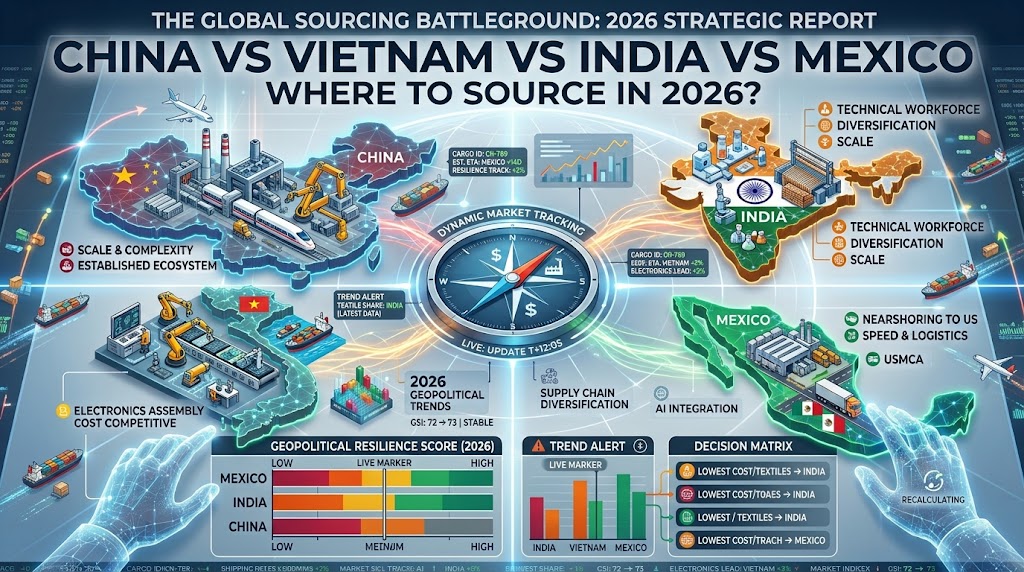
The global manufacturing geography has shifted permanently. For decades, single-country sourcing out of China offered unmatched economies of scale and seamless supplier ecosystems. In 2026, rising labor rates, trade enforcement measures, and compounding Section 301 tariffs make relying exclusively on a single origin point an existential financial risk.
Businesses building resilient supply chains are actively deploying “China Plus One” sourcing strategies. The decision is no longer about finding the absolute lowest labor cost; it is about balancing unit pricing against ocean transit times, tariff exposure, and component ecosystem density. Below is a direct breakdown of the four dominant sourcing hubs for 2026.
China: Unmatched Industrial Scale and Component Density
China remains the undisputed leader for complex manufacturing, rapid scalability, and mature component ecosystems. If your product requires intricate tooling, specialized sub-components, or massive production runs, replacing Chinese factories entirely remains difficult.
However, the trade-offs are significant. Chinese exports face high Section 301 tariffs and strict regulatory scrutiny at U.S. ports. Importers continuing to source from China must run rigorous classification audits and maintain an active customs strategy to manage elevated landed costs.
Vietnam: The Premier China Plus One Assembly Destination
Vietnam has emerged as the most popular immediate alternative for businesses diversifying out of China, particularly for consumer electronics, apparel, footwear, and furniture. Its geographical proximity to South China allows factories to source raw materials quickly while shipping finished goods under favorable trade terms.
The primary limitation is component dependency. Vietnam functions predominantly as an assembly hub, relying heavily on imported raw materials. Importers must verify that goods undergo “substantial transformation” in Vietnam to legally claim Vietnamese country of origin and avoid Chinese tariff reassessments.
India: Scalable Labor and Expanding Industrial Capacity
India offers unmatched labor scale, competitive wage rates, and rapidly expanding manufacturing capabilities under aggressive government incentive schemes. It excels in cotton textiles, pharmaceuticals, industrial hardware, and a rapidly growing consumer electronics assembly sector.
While India provides the lowest raw labor overhead, challenges remain around inland logistics infrastructure, port bottlenecks, and varying factory yield consistency. Importers sourcing out of India should establish strict pre-production quality checks and account for longer sea transit cycles to Western ports.
Mexico: High-Speed Nearshoring and Duty-Free USMCA Access
For North American brands, Mexico represents the ultimate nearshoring hub for automotive components, medical devices, mid-volume electronics, and industrial hardware. Sourcing out of Mexico reduces transit times from weeks down to a few days via cross-border trucking or short-sea shipping.
Although Mexican labor costs are higher than in Southeast Asia, the total landed cost is heavily offset by zero-tariff entry under USMCA and drastically reduced freight charges. Qualifying goods under USMCA also bypass the Merchandise Processing Fee (MPF), creating substantial ongoing savings.
How to Select the Right Sourcing Hub for Your Enterprise
Choosing the optimal manufacturing location depends entirely on your specific product category, order volume, and time-to-market priorities:
- Speed to Market & Nearshoring: Choose Mexico for 4-to-8 day lead times, low inventory holding risk, and USMCA tariff exemptions.
- Labor-Intensive Assembly: Choose Vietnam for footwear, apparel, furniture, and consumer assembly backed by Chinese component supply lines.
- Low-Cost Scale & Technical Goods: Choose India for textiles, pharmaceuticals, and high-volume manufacturing requiring low wage rates.
- Complex Tooling & High Ecosystem Density: Retain primary or secondary capacity in China for specialized engineering and massive volume runs.
Frequently Asked Questions
Which country offers the fastest transit time to the U.S. market? Mexico offers the fastest transit time, taking 4 to 8 days via overland trucking or short-sea shipping compared to 20 to 35 days from Asian manufacturing hubs.
Does sourcing out of Vietnam eliminate all Chinese tariff risks? Not automatically. Simply routing Chinese components through Vietnam for basic assembly without meeting substantial transformation rules can lead to origin reassessments by U.S. Customs.
Why is Mexico often preferred over Asian alternatives despite higher labor costs? Mexico provides zero tariff entry for qualifying goods under USMCA, drastically reduced ocean freight fees, shorter inventory replenishment cycles, and lower working capital exposure.
If you are planning a China Plus One transition or nearshoring to Mexico, confirm your origin documentation before cargo ships. Book a Free Consultation Call with AIT TAHIPO LLC and we will analyze your rules of origin, evaluate total landed costs, and secure available tariff preferences.