
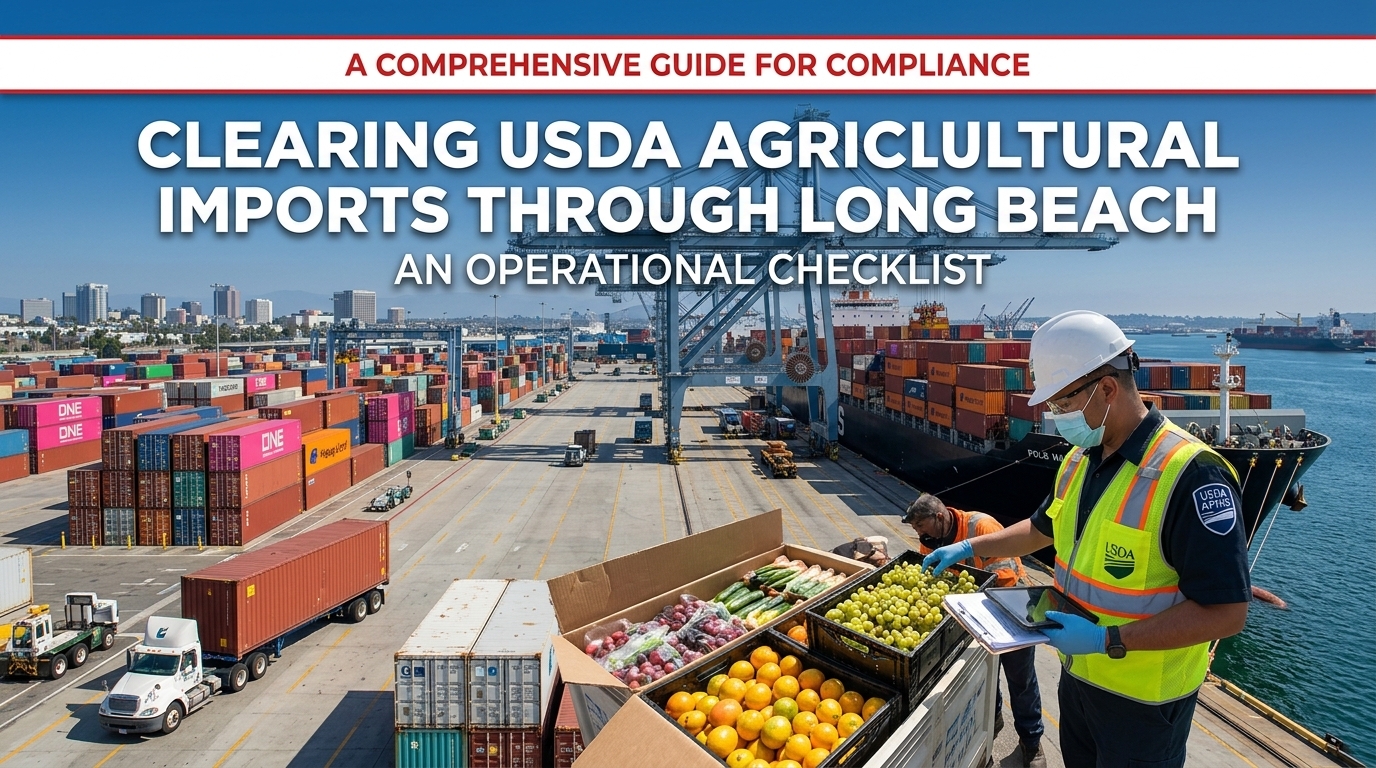
Clearing USDA. Agricultural cargo arriving at the Port of Long Beach faces strict joint oversight from U.S. Customs and Border Protection (CBP) Agriculture Specialists and the USDA’s Animal and Plant Health Inspection Service (APHIS). A single missing phytosanitary certificate or incorrect treatment protocol can freeze a container on the terminal, generating thousands of dollars in daily demurrage charges or triggering mandatory re-exportation.
Successfully navigating agricultural clearance requires pre-arrival documentation, physical hold coordination, and partner agency sign-offs.
Phase 1: Pre-Arrival & Clearing USDA Documentation
Documentation errors cause the majority of initial agricultural holds. When clearing USDA shipments, importers must assemble and verify all regulatory certificates prior to vessel discharge:
- Obtain active USDA APHIS permits (such as PPQ Form 587 for plants or VS Form 16-6A for animal products) tailored to the specific country of origin and botanical or animal species.
- Secure the original foreign Phytosanitary Certificate issued by the exporting country’s National Plant Protection Organization (NPPO), ensuring exact match on weights, descriptions, and treatments.
- Confirm your ocean carrier submits the Automated Manifest System (AMS) data at least 24 hours prior to foreign loading to avoid manifest discrepancies.
- Transmit partner government agency (PGA) message sets through the Automated Commercial Environment (ACE) during initial entry summary filing.
Phase 2: Port Holds & Clearing USDA Inspections
Upon arrival at the Port of Long Beach, CBP Agriculture Specialists evaluate entry data to determine whether cargo requires physical sampling or agricultural examination:
- Check ACE status notifications for Agriculture Holds (1A) or Emergency Action Notifications (EAN / Form PPQ 523).
- Coordinate drayage to an approved Centralized Examination Station (CES) if CBP orders a full container devanning and inspection.
- Ensure wood packaging material (WPM) strictly complies with ISPM-15 international standards, bearing legible stamps on all pallets and dunnage to avoid immediate quarantine.
Phase 3: Quarantine Treatment & Final Release
If inspectors detect actionable pests or prohibited plant residue during the process of clearing USDA cargo, the shipment enters quarantine protocol:
- Secure an official USDA-approved treatment order if a fumigation or cold-treatment option is granted on the EAN.
- Transfer cargo via bonded, seal-verified transport to a licensed USDA-certified treatment facility near the port complex.
- Obtain official USDA sign-off following successful treatment or secondary re-inspection to trigger final electronic release in ACE before returning the container to domestic chassis.
FAQ
What happens if CBP Agriculture Specialists find an actionable pest in my cargo at Long Beach?
CBP issues an Emergency Action Notification (EAN). Depending on the pest classification, you will be given options to treat the cargo at an approved local facility, re-export the shipment, or destroy it under government supervision.
Can USDA-regulated agricultural goods be inspected directly at the terminal quay?
Most detailed agricultural exams occur at a designated off-dock Centralized Examination Station (CES) equipped for devanning, re-cooling, and intensive sampling, rather than at the ocean terminal.
How does non-compliant wood packaging material (WPM) affect cargo release?
Untreated or unstamped WPM triggers immediate separation. CBP can order the re-exportation of the entire shipment if the non-compliant wood cannot be safely separated from the cargo on site.
Who pays for fumigation or quarantine services at the port?
The importer of record bears full financial responsibility for all CES transfer fees, devanning costs, USDA-supervised treatments, and terminal demurrage accrued during holds.
Do fresh produce imports require additional Partner Government Agency filings?
Yes. Beyond USDA APHIS, most fresh food and produce imports require FDA Prior Notice filings and must meet USDA Agricultural Marketing Service (AMS) grade standards.
Book a Free Consultation Call to review your agricultural import workflow. We verify APHIS permits, audit foreign phytosanitary documentation, and manage port inspections to prevent costly agricultural holds at Long Beach.
Maintaining Compliance for Long Beach Agricultural Imports
Preventing costly port delays requires proactive coordination well before cargo reaches the terminal. Establishing direct communication with CBP Agriculture Specialists, maintaining strict ISPM-15 packaging compliance, and auditing phytosanitary documentation prior to vessel departure protects your supply chain from unexpected Emergency Action Notifications (EANs). Importers who regularly audit their pre-arrival workflows avoid thousands of dollars in daily demurrage while ensuring fast clearance through the Port of Long Beach.