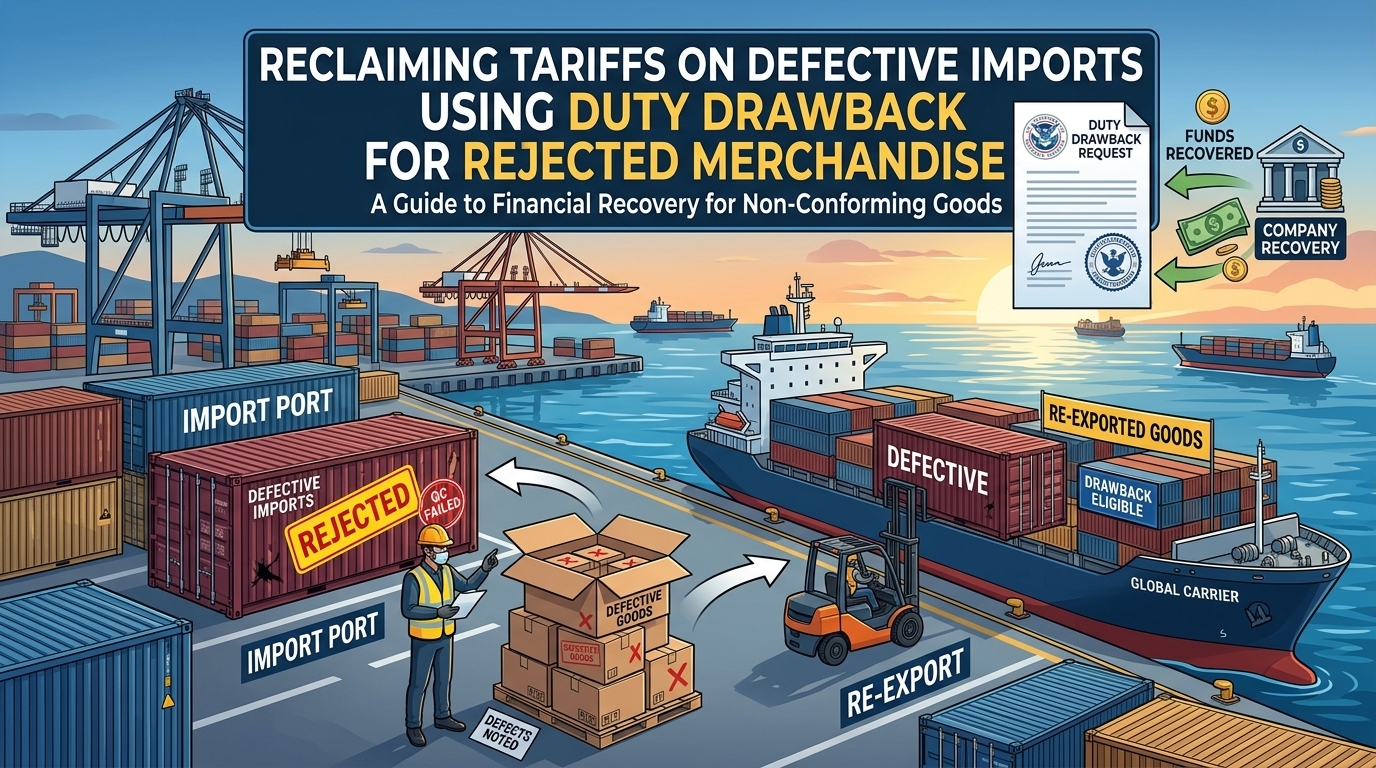
When imported merchandise arrives defective, damaged, non-conforming to specifications, or shipped without the consent of the consignee, paying customs duties, taxes, and fees feels like adding insult to injury. Under U.S. customs law, importers don’t have to absorb these financial losses permanently. The United States Customs and Border Protection (CBP) provides a statutory mechanism—specifically 19 U.S.C. 1313(c), known as Rejected Merchandise Duty Drawback—that allows importers to recover up to 99 percent of the duties, taxes, and fees paid on imported goods that are subsequently exported or destroyed under CBP supervision.
Despite its financial benefits, duty drawback remains one of the most underutilized trade remedy programs in international logistics. Navigating the regulatory requirements governed by 19 CFR Part 190 (and the modernized TFTEA drawback provisions under 19 CFR Part 191) requires strict adherence to evidence compilation, operational timelines, and precise filing procedures through the Automated Commercial Environment (ACE).
Statutory Grounds for Rejected Merchandise Drawback
To qualify for a refund of duties under 19 U.S.C. 1313(c), the imported merchandise must satisfy at least one of four statutory classifications at the time of importation or discovery:
- Defective Merchandise: The goods possess physical defects, manufacturing flaws, or structural damage that render them unfit for their intended commercial purpose.
- Non-Conforming Goods: The merchandise fails to meet written purchase specifications, quality standards, engineering tolerances, or sample approvals agreed upon between the buyer and foreign seller prior to importation.
- Goods Shipped Without Consent: The shipment was dispatched by the vendor without the express order, authorization, or consent of the importer (e.g., duplicate orders or unauthorized SKU substitutions).
- Goods Failing Sample or Specification Verification: The merchandise does not perform according to technical guarantees or functional testing metrics set forth in the underlying purchase contract.
Understanding the TFTEA Modernization Standard
The Trade Facilitation and Trade Enforcement Act (TFTEA) modernized duty drawback regulations, offering streamlined administrative processes while establishing clearer standard rules for substitution and accounting. Under traditional drawback rules, importers had to match exported or destroyed goods strictly to specific import entries using direct identification (often tracking individual serial numbers).
Under TFTEA, importers can utilize substitution drawback for rejected merchandise in specific categories, provided the exported or destroyed goods share the exact same 8-digit Harmonized Tariff Schedule (HTS) statistical reporting number as the imported goods. However, for rejected merchandise specifically, direct identification remains the most straightforward legal path to prove that the defective items being exported or destroyed are the exact units entered under the original CBP Form 7501.
The Four-Step Operational Drawback Process
Recovering tariffs on defective imports requires a methodical operational workflow executed before the merchandise leaves the country or undergoes destruction.
Step 1: Establishing the Defect and Commercial Non-Conformance
The moment a defective shipment is identified in your warehouse or distribution center, document the non-conformance thoroughly. Don’t return or destroy the goods immediately. CBP requires clear commercial and technical evidence establishing that the goods failed to conform to contract terms upon entry.
Assemble a comprehensive defect file containing:
- Purchase orders and technical specifications demonstrating agreed-upon quality criteria.
- Inspection reports, laboratory testing results, or quality control logs detailing the specific defects.
- Supplier communications, emails, or formal Notices of Rejection sent to the foreign vendor.
- Credit memos, debit notes, or revised commercial settlement agreements.
Step 2: Issuing Notice of Intent to Export or Destroy (CBP Form 7571)
CBP must be given the opportunity to physically inspect the defective merchandise prior to its export or destruction. Under 19 CFR 190.42, the importer or drawback claimant must file a Notice of Intent to Export, Destroy, or Return Merchandise for Drawback (CBP Form 7571) with the local CBP Drawback Office at least 5 working days before the scheduled export date, or 7 working days prior to the planned destruction.
The Notice of Intent must detail:
- The specific location where the goods are stored and available for CBP physical examination.
- The entry numbers, entry dates, and port of entry corresponding to the original import filings.
- Detailed descriptions of the goods, including part numbers, serial numbers, quantity, and HTS classifications.
- The specific reason for rejection (defective, non-conforming, or shipped without consent).
If CBP waives physical examination, the agency will issue a signed waiver on Form 7571, authorizing the claimant to proceed with exportation or destruction. If CBP elects to examine the merchandise, an import specialist or officer will inspect the goods at the warehouse to verify that the item descriptions and physical condition match the claim documents.
Step 3: Execution under CBP Supervision or Certified Destruction
Once CBP approves Form 7571 or waives inspection, the physical disposition must be completed:
- Exportation: The merchandise must be exported under customs supervision or verified through clean export documentation, including Bills of Lading, Electronic Export Information (EEI) filings in the Automated Export System (AES), and carrier tracking manifests.
- Destruction: If exporting the goods back to the supplier is commercially unfeasible or ecologically restricted, the merchandise can be destroyed under CBP supervision or at an approved commercial destruction facility. A formal Certificate of Destruction (CBP Form 7553) signed by an authorized destruction facility operator and witnessed by CBP officers (or documented via video audit if pre-approved) must be secured.
Step 4: Filing the Drawback Claim in ACE
With export or destruction verified, the final administrative step is transmitting the electronic drawback claim via ACE within the statutory timeframe.
Under current TFTEA guidelines, drawback claims must be filed within 5 years from the date of importation of the merchandise. The claim calculation encompasses:
- 99% of paid ordinary customs duties.
- 99% of Section 301, Section 232, or other special trade remedy tariffs paid at entry.
- 99% of merchandise processing fees (MPF) and harbor maintenance fees (HMF) attributable to the rejected entries.
Accelerated Payment Privileges and Drawback Bonds
Standard drawback claim processing can take anywhere from six months to two years before CBP issues a refund check. To eliminate this cash-flow delay, eligible importers should apply for Accelerated Payment Privileges under 19 CFR 190.92.
By securing a 1-type Continuous Customs Drawback Bond, importers approved for accelerated payment receive their 99% duty refund within 30 to 60 days of electronic claim submission in ACE. CBP then audits the claim retroactively. If an audit reveals discrepancies or unsubstantiated claims, CBP issues a demand for redelivery or duty recovery against the drawback bond.
FAQ
Can I claim duty drawback on defective goods if the supplier gives me a full refund?
Yes. Receiving a commercial refund or credit memo from your foreign supplier doesn’t prevent you from claiming duty drawback. Customs duties are paid to the U.S. government, not the vendor. As long as you export or destroy the goods following CBP protocols, you’re legally entitled to recover 99% of the duties paid to CBP.
What happens if I already exported the defective goods before notifying CBP?
If you exported defective merchandise without filing CBP Form 7571 or securing a prior examination waiver, standard 1313(c) rejected merchandise drawback will likely be denied. However, under TFTEA regulations, you may explore whether the goods qualify under Unused Merchandise Drawback (19 U.S.C. 1313(j)(1)), provided strict tracking records exist and the goods were never put to commercial use in the United States.
Are Section 301 tariffs on Chinese imports eligible for duty drawback?
Yes. Section 301 duties, Section 232 steel and aluminum tariffs, and standard column 1 duty rates are fully eligible for 99% duty drawback recovery under rejected merchandise claims.
What is the fee retained by CBP on drawback refunds?
CBP retains 1 percent of the total eligible duty, tax, and fee amount as an administrative handling fee. The claimant receives a 99 percent refund.
Can merchandise be destroyed instead of shipped back to the foreign vendor?
Yes. 19 U.S.C. 1313(c) explicitly allows for the destruction of rejected merchandise under CBP supervision or approved destruction facilities as an equivalent alternative to foreign re-exportation.
Book a Free Consultation Call if you have defective import shipments. We audit your import entries, draft CBP Form 7571 filings, coordinate certified destructions, and transmit accelerated ACE drawback claims to maximize your duty recovery.