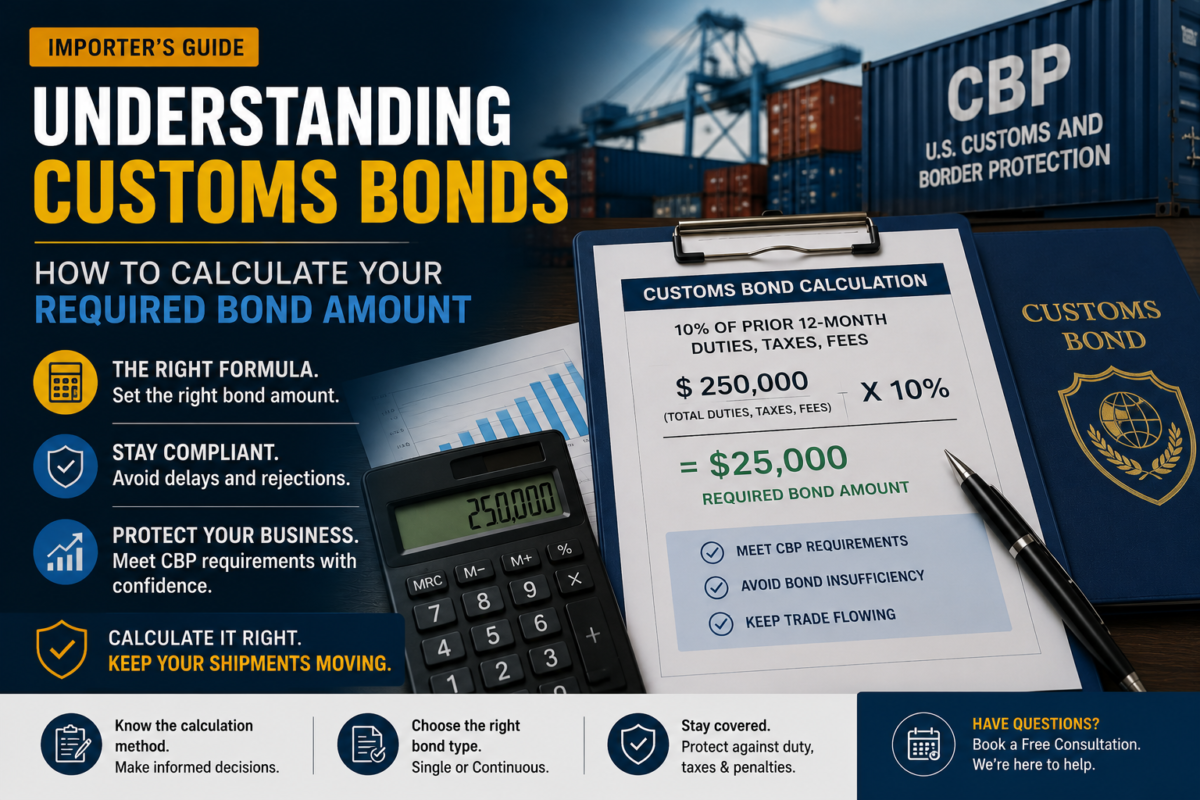
CBP won’t release your cargo without a bond on file, and the amount isn’t something you get to guess at. There’s a formula, and getting it wrong in either direction costs you: too low, and CBP rejects the entry or demands a bond increase mid-shipment; too high, and you’re paying premium on coverage you don’t need.
The Baseline Formula for a Continuous Bond
For most importers filing a continuous bond, which covers all entries over a full year rather than a single shipment, CBP’s baseline calculation is 10% of the total duties, taxes, and fees paid over the prior 12 months, with a $50,000 minimum. If your business paid $300,000 in duties last year, your bond should be set at roughly $30,000, unless another factor in your import profile pushes it higher.
That’s the floor calculation, not the whole picture. CBP’s bond sufficiency formula also weighs the type of merchandise you import. Goods subject to Partner Government Agency requirements, quota categories, or antidumping and countervailing duty orders get bonded at a higher rate because the potential duty liability, and the risk if something goes wrong, is materially higher than for an ordinary commercial shipment.
Single Transaction Bonds Work Differently
If you’re a one-off or infrequent importer, a single transaction bond covering just that shipment usually makes more financial sense than a continuous bond. The minimum here is the total entered value plus estimated duties, taxes, and fees, though for goods under FDA, USDA, or other PGA jurisdiction, CBP typically requires the bond amount to be three times the entered value rather than just covering the duty owed. That multiplier surprises a lot of first-time importers of regulated products, who expect to bond just the duty amount and get quoted something far higher.
| Bond Type | Baseline Calculation | Typical Minimum |
|---|---|---|
| Continuous bond, standard goods | 10% of prior 12-month duties, taxes, fees | $50,000 |
| Continuous bond, PGA/quota/ADD-CVD goods | 10% baseline plus risk-adjusted increase | Varies, often $75,000+ |
| Single transaction bond, standard goods | Entered value + duties, taxes, fees | Shipment-specific |
| Single transaction bond, PGA-regulated goods | 3x entered value | Shipment-specific, often much higher |
Why Your Bond Amount Changes Mid-Year
CBP reviews continuous bond sufficiency periodically, and if your import volume or duty exposure grows faster than your bond covers, you’ll get a bond insufficiency notice requiring an increase, sometimes with a short window to comply before entries start getting rejected. This happens most often to importers who had a strong growth year, added a new high-tariff product line, or picked up a supplier now subject to an antidumping order they weren’t dealing with before.
The fix is straightforward if you catch it early: recalculate based on trailing 12-month duty payments plus your growth trajectory, and adjust the bond before CBP flags it rather than after. Waiting for the insufficiency notice means you’re reacting under a deadline instead of planning on your own schedule.
Where IEEPA and Tariff Actions Complicate the Math
Recent tariff actions under IEEPA authority have added duty exposure on a wide range of goods from specific countries, and that exposure counts toward your bond calculation the same as any other duty. If a meaningful share of your import volume now carries an added IEEPA tariff layer on top of the normal HTS rate, your trailing 12-month duty base, and therefore your required bond, can jump substantially even if your shipment volume stayed flat. If you’ve paid these tariffs and believe you may have grounds for a refund, our IEEPA tariff refund team reviews entries for exactly this kind of overpayment.
The Cost of Getting the Bond Wrong
An insufficient bond doesn’t just risk a rejected entry. If your bond amount doesn’t cover a liability CBP later assesses against you, whether from a CF-29 duty increase, a penalty, or a liquidated damages claim, the surety only pays out up to your bonded amount. Anything above that is your exposure directly, with no bond standing between you and the bill.
Not sure your bond covers your actual duty exposure? Let’s check it.
Message Us on WhatsApp for a Free QuoteFrequently Asked Questions
Who actually calculates my bond amount, me or CBP?
Your surety or broker runs the calculation using your duty history, but CBP has final authority to reject a bond as insufficient regardless of what the surety approved.
Can I switch from a single transaction bond to a continuous bond mid-year?
Yes, and most regular importers should. A continuous bond typically costs less over a full year than paying for single transaction bonds shipment by shipment once you’re importing more than four or five times annually.
What happens if CBP rejects my bond as insufficient at the port?
Your entry doesn’t get released until a sufficient bond is on file. For continuous bond holders, this usually means an expedited rider or increase filed with the surety, which can take a day or more depending on your surety’s responsiveness.
Does my bond amount ever go down?
Yes, if your trailing 12-month duty payments drop, you can request a reduction at renewal, though sureties are generally more conservative about lowering bond amounts than raising them.
Are customs bonds the same as cargo insurance?
No. A customs bond guarantees payment of duties, taxes, and compliance obligations to the government. It has nothing to do with insuring the value of your goods against loss or damage in transit.
Does a bad compliance history affect my bond amount?
Yes. A history of penalties, liquidated damages claims, or repeated bond insufficiencies can push your surety to require a higher bond or additional collateral, separate from the standard duty-based calculation.
How often should I recheck my bond sufficiency?
At minimum annually at renewal, but if you’ve added a new product line, a new supplier country, or absorbed a tariff action affecting your goods, recalculate sooner rather than waiting for the renewal date or a CBP notice.
More Questions Importers Are Asking
How is a customs bond amount actually calculated?
CBP’s standard formula for a continuous bond is 10 percent of the total duties, taxes, and fees your business paid over the trailing 12 months, with a $50,000 floor. A single transaction bond is calculated differently, generally set at the total entered value plus estimated duties, taxes, and fees for that one shipment. Goods regulated by a Partner Government Agency can push the single transaction bond up to three times the entered value.
How do you determine which bond amount applies to your business?
Start with your trailing 12-month duty, tax, and fee payments and apply the 10 percent continuous bond formula. Then check whether any of your goods fall under a Partner Government Agency requirement, a quota category, or an active antidumping or countervailing duty order, since any of those can push your required bond above the standard baseline.
What is the minimum bond amount CBP will accept?
For a continuous bond, $50,000 is the standard floor regardless of how low your actual 10 percent calculation comes out to. There’s no fixed minimum figure for single transaction bonds since that amount scales directly with the entered value and duty owed on the specific shipment.
How does CBP decide when to change my bond amount?
CBP periodically reviews continuous bonds against your actual trailing 12-month duty, tax, and fee payments. If your import volume, product mix, or duty exposure grows enough that your current bond no longer covers 10 percent of that trailing total, CBP issues an insufficiency notice requiring an increase. Unpaid CBP invoices in that same period can also trigger a bond review outside the normal cycle.
Do regulated goods always require a higher bond than standard merchandise?
Generally, yes. Goods that fall under FDA, USDA, or other Partner Government Agency jurisdiction carry more risk from CBP’s perspective, since a compliance failure on regulated goods can be more costly to unwind than a standard commercial shipment. That’s why single transaction bonds on PGA-regulated goods are typically set at three times the entered value instead of just covering the duty owed.