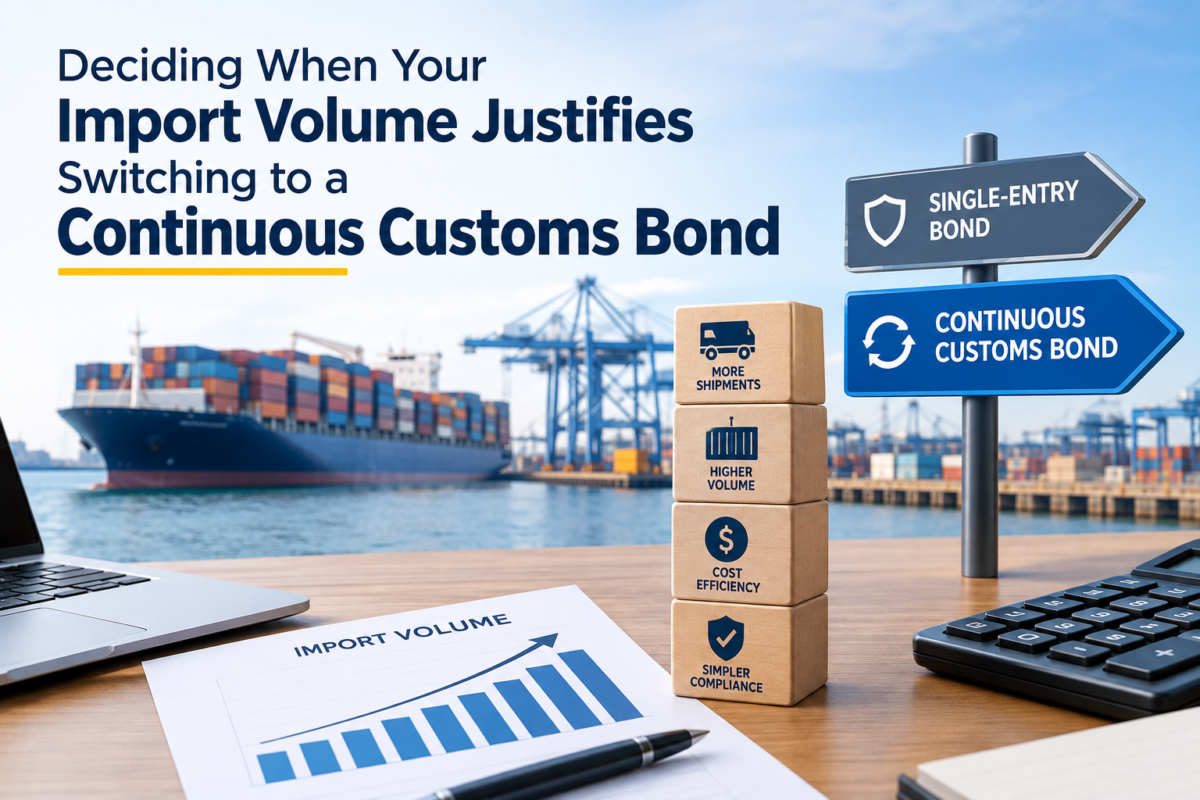
Every commercial shipment entering the United States must be covered by a customs bond under 19 U.S.C. 1623. The bond acts as a legal guarantee to CBP that all duties, taxes, and fees will be paid and that commercial entry regulations will be met. Importers choose between two mechanisms: Single Transaction Bonds (STBs) for individual entries or an annual Continuous Customs Bond.
Operating on single transaction bonds past a certain shipping volume generates unnecessary clearance fees, creates clearance bottlenecks, and complicates logistics management.
Economics and Mechanics of Import Bonds
Selecting the right bond type requires an understanding of how costs and coverage limits are structured:
Single Transaction Bonds (STB): Purchased on a per-shipment basis through a customs broker, STBs generally cost between $50 and $150 per entry, or a percentage of entered shipment value. They cover only the specific entry summary for which they are written.
Continuous Customs Bonds: Written as an annual contract running 12 months, continuous bonds cover all import entries through any U.S. port. The minimum bond amount required by CBP is $50,000, which typically carries an annual surety premium between $450 and $600.
Coverage Calculations and Sufficiency Limits: An STB must generally equal the entered value of the goods plus duties, taxes, and fees (or three times that value if goods are subject to partner government agency regulations). A standard $50,000 continuous bond covers up to $500,000 in annual duties, taxes, and fees paid to CBP.
Four Metrics to Determine When to Switch
Calculate Your Annual Entry Frequency: If your business processes more than four to six commercial ocean or air shipments per year, single transaction bond fees will exceed the flat annual premium of a continuous bond.
Factor in ISF Bond Requirements: For ocean freight, importers must file an Importer Security Filing (ISF 10+2). Without a continuous bond, brokers charge an additional $50 to $100 for an independent ISF single transaction bond for each ocean bill of lading, halving the break-even threshold.
Evaluate Partner Government Agency (PGA) Involvements: Shipments regulated by agencies such as the FDA, EPA, or USDA require STB amounts set at three times the entered commercial value. For high-value or regulated shipments, the cost of a single STB can equal or surpass the price of an annual continuous bond.
Eliminate Clearance Processing Friction: Continuous bonds are filed electronically and maintained centrally in the Automated Commercial Environment (ACE). This eliminates the administrative turnaround required for brokers to secure underwritten STBs for separate cargo arrivals, removing border holds.
Managing Bond Sufficiency as Volumes Grow
CBP monitors duty payments over a rolling 12-month window. The base continuous bond formula requires bond coverage equal to at least 10% of the duties, taxes, and fees paid during the prior year. If rapid business growth causes your duty liability to surpass $500,000 annually, CBP issues an automated bond insufficiency letter, requiring you to increase bond coverage within 30 days to prevent entry processing suspensions.
FAQ
How long does it take to activate a continuous customs bond?
A continuous customs bond can be underwritten, filed, and activated directly in CBP’s ACE system within 24 to 48 hours.
Does a continuous bond cover imports across multiple U.S. ports?
Yes. A single continuous bond covers import transactions across all U.S. ports of entry, regardless of which customs broker files the entry.
Who writes the continuous bond CBP or an insurance company?
Continuous bonds are underwritten by commercial surety companies licensed by the U.S. Department of the Treasury and are held by CBP as obligee.
Can multiple corporate subsidiaries share the same continuous bond?
Yes, related corporate entities can be added as co-principals or bonded divisions to a single continuous bond, provided they share legal alignment and corporate ownership structures.
What happens if my continuous bond runs out of capacity?
If your annual duty liability exceeds the coverage threshold, CBP flags the bond as insufficient. You will receive 30 days to execute an increase to a higher limit (e.g., $100,000) before CBP stops accepting new entries.
Book a Free Consultation Call to analyze your shipping frequency, calculate bond sufficiency requirements, and secure a continuous customs bond for your import operations.