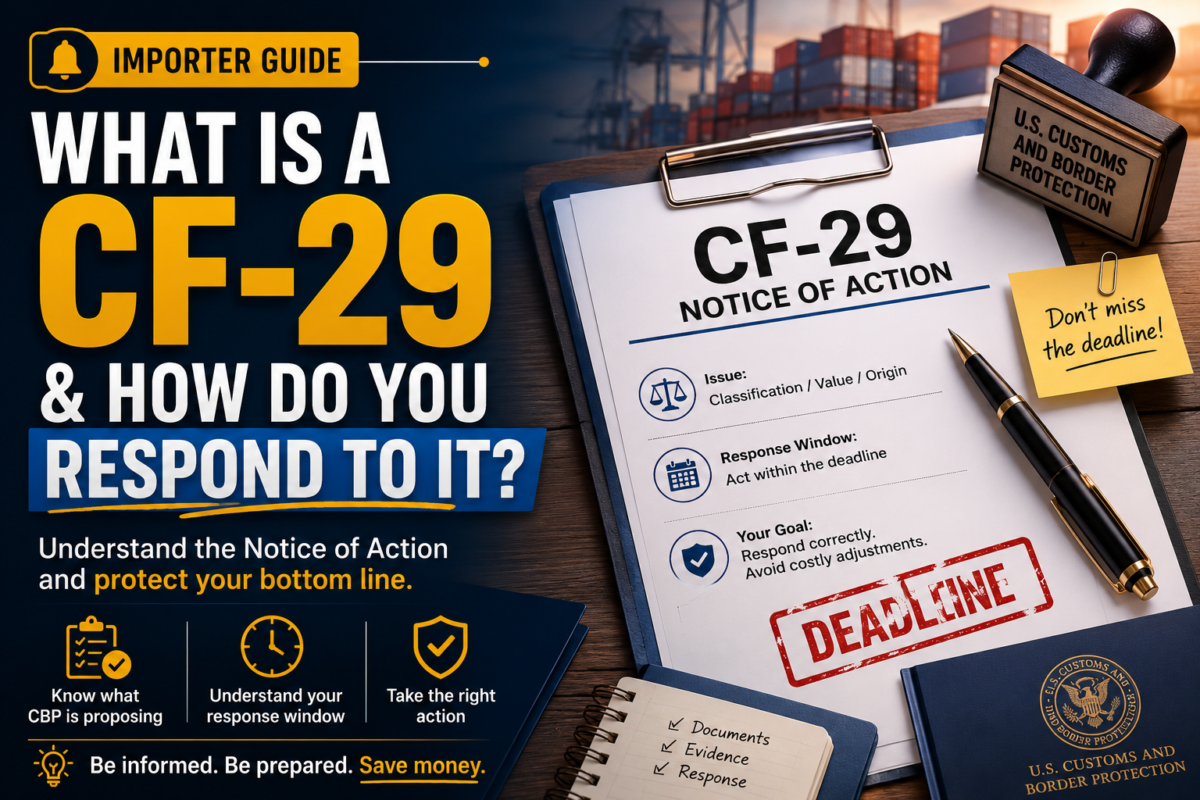
A CF-29 lands in your inbox looking like a form, but it’s really a proposal from CBP to change how one of your entries was treated, and it comes with a clock attached. Ignore it or respond badly, and the proposed change becomes final. Respond correctly, and you can often keep your original classification, valuation, or origin determination intact.
What a CF-29 Actually Says
The form has two boxes that matter. One states the proposed action: a reclassification to a different HTS subheading, a change in appraised value, a different country of origin determination, or an antidumping/countervailing duty rate adjustment. The other states whether it’s a “proposed” action, meaning you have a window to respond, or a “final” action, meaning CBP has already made the decision and this is notice after the fact.
That distinction changes your entire strategy. A proposed CF-29 is a negotiation. A final CF-29 is a bill, and your remaining options are protest or Post Summary Correction, not persuasion.
Reading Between the Lines of the Reason Code
CBP is required to state a reason for the action, and this is usually where importers get the most useful information for their response. A classification change often cites a specific Explanatory Note or prior CBP ruling the officer believes applies to your product. A valuation change usually points to a discrepancy between your declared value and either the transaction value rules under 19 USC 1401a or information CBP pulled from a different source, sometimes a competitor’s entry data for a similar product.
Whatever the stated reason, that’s the exact argument you need to rebut, point by point, not a general statement that your original filing was correct.
| CF-29 Type | Your Response Window | Your Best Move |
|---|---|---|
| Proposed classification change | Typically 20 days from date of notice | Submit a rebuttal with ruling citations, product specs, and samples if needed |
| Proposed valuation change | Typically 20 days | Provide transaction value documentation, related-party pricing studies if applicable |
| Final action, unliquidated entry | Before liquidation date | File a Post Summary Correction with supporting evidence |
| Final action, liquidated entry | 180 days from liquidation | File a protest under 19 USC 1514 |
Building the Rebuttal
Start with the tariff engineering or classification logic you used originally, and back it with the General Rules of Interpretation, not just a description of the product. If you have a binding ruling on an identical or near-identical item, even one issued to a different importer, cite it. CBP rulings are public and searchable, and a directly on-point ruling carries real weight.
For valuation disputes, the strongest response usually includes the actual commercial invoice, proof of payment, and, where the buyer and seller are related parties, a transfer pricing study or comparable uncontrolled price analysis showing the declared value reflects arm’s length terms.
Submit everything through your customs brokerage team rather than sending documents directly to the port. A rebuttal that arrives disorganized, or missing a cover letter tying each document to the specific reason code CBP cited, tends to get less attention than one that mirrors CBP’s own reasoning back at them.
When the CF-29 Becomes Final Anyway
If CBP isn’t persuaded and the action becomes final, you’re not out of options. For entries that haven’t liquidated yet, a Post Summary Correction lets you or your broker file a corrected entry summary with the additional duty paid under protest, preserving your right to argue the point later without holding up the entry. Our duty drawback desk gets pulled in here often, because overpaid duty on a corrected entry sometimes qualifies for later recovery if the underlying goods are re-exported or used in a way that triggers drawback eligibility.
Once an entry has liquidated, your only avenue is a formal protest under 19 USC 1514, filed within 180 days of the liquidation date. This is a different, more formal process than a rebuttal letter, and it needs to cite the specific legal basis for disagreement, not just repeat your original position.
The Cost of Doing Nothing
A CF-29 that goes unanswered simply becomes CBP’s position. There’s no default win for the importer. If you’re carrying multiple SKUs under the classification CBP is proposing to change, one unanswered notice can become the precedent CBP applies to every future entry of that product, which turns a single-entry dispute into a permanent duty rate increase across your entire import program.
Received a CF-29? The response window is short and it’s already ticking.
Message Us on WhatsApp for a Free QuoteFrequently Asked Questions
Do I have to respond to a proposed CF-29?
No, but not responding means the proposed action becomes final by default. Silence isn’t neutral here.
Can I request an extension to respond?
Yes, in most cases you can request additional time from the issuing port, particularly if you need to pull technical documentation or a lab analysis. Ask before the deadline, not after.
Does a CF-29 affect only the entry it’s attached to?
Directly, yes, but the classification or valuation logic CBP applies can carry forward to future entries of the same merchandise unless you successfully rebut it.
What’s the difference between a CF-29 and a CF-28?
A CF-28 is a Request for Information, asking you to provide documentation before CBP decides anything. A CF-29 comes after that, stating what CBP has decided or proposes to decide.
Can my broker file the response for me?
Yes, and it’s usually the faster path, since the broker already has the entry data and can assemble the rebuttal package without you tracking down documents from scratch.
What happens if I miss the protest deadline after a final CF-29?
The 180-day window is firm. Miss it, and the liquidated rate stands with no further administrative appeal available for that entry.
Is a CF-29 the same as a penalty notice?
No. A CF-29 addresses classification, value, or origin on a specific entry. Penalty notices under 19 USC 1592 involve allegations of negligence or fraud and carry separate, more serious exposure.
More Questions Importers Are Asking
What exactly is a CF-29?
A CF-29, formally called a Notice of Action, is CBP’s written notice that it’s changing, or proposing to change, how a specific entry was classified, valued, or treated for duty purposes. Think of it as CBP telling you there’s a problem with how an entry was filed and what they intend to do about it, either as a proposal you can respond to or a decision already made.
How many days do you actually have to respond to a CF-29?
For a proposed action, the standard window is 20 days from the date on the notice. Miss that window and CBP proceeds with the proposed change as if you’d agreed to it. Final actions don’t carry the same 20-day response window, since the decision has already been made. Your recourse there shifts to a Post Summary Correction or a protest, depending on whether the entry has liquidated.
What’s the difference between a CF-28 and a CF-29?
A CF-28 is a Request for Information. CBP is asking you to provide documentation, usually before they’ve decided anything, so they can evaluate the entry properly. A CF-29 comes later in the process and states CBP’s actual proposed or final decision. Getting a CF-28 doesn’t automatically mean a CF-29 is coming, but a well-documented response to the CF-28 is often what prevents one.
Who at CBP issues a Notice of Action?
The import specialist or entry review team at the port that processed your entry issues the CF-29. That’s also who you or your broker respond to directly, since they’re the one who reviewed the file and made the initial determination.
Can I get an extension on my CF-29 response deadline?
Yes, in most cases the port will grant a reasonable extension if you request it before the original deadline passes, particularly when you need time to pull technical specs, a lab report, or a ruling citation. Requesting an extension after the deadline has already lapsed rarely works, since by then the proposed action may have already gone final.
Does responding to a CF-29 guarantee CBP will reverse the proposed action?
No. A well-documented rebuttal improves your odds significantly, especially when it directly addresses the reason code CBP cited, but the officer reviewing your response makes the final call. If they’re not persuaded, the action goes final and your options move to a Post Summary Correction or a formal protest.