
Understanding Emergency Trade Remedies and Duty Recovery Channels
The operational framework governing international trade requires small business owners to maintain sharp oversight regarding import liabilities. Emergency import controls authorized under the International Emergency Economic Powers Act (IEEPA) allow executive actions to impose secondary baseline border assessments during designated crises. While these duty lines significantly alter supply chain margins, subsequent court decisions can change their legal standing, opening massive recovery windows for corporate entities.
To navigate these updates, small businesses must look beyond day-to-day logistics to focus on technical recovery steps. When federal oversight programs change or court orders mandate modifications, the resulting claims pool can reverse capital loss. Returning your entry data back to a clean state requires structured documentation analysis and direct communication paths with your clearing agents.
The Launch of the CAPE Portal Architecture
To manage the high volume of claims resulting from changing legal rulings, specialized administrative structures are deployed. U.S. Customs and Border Protection launched the Consolidated Administration and Processing of Entries (CAPE) tool directly inside the official ACE Secure Data Portal. This centralized digital workspace serves as the exclusive processing channel to compile, validate, and execute emergency refund declarations.
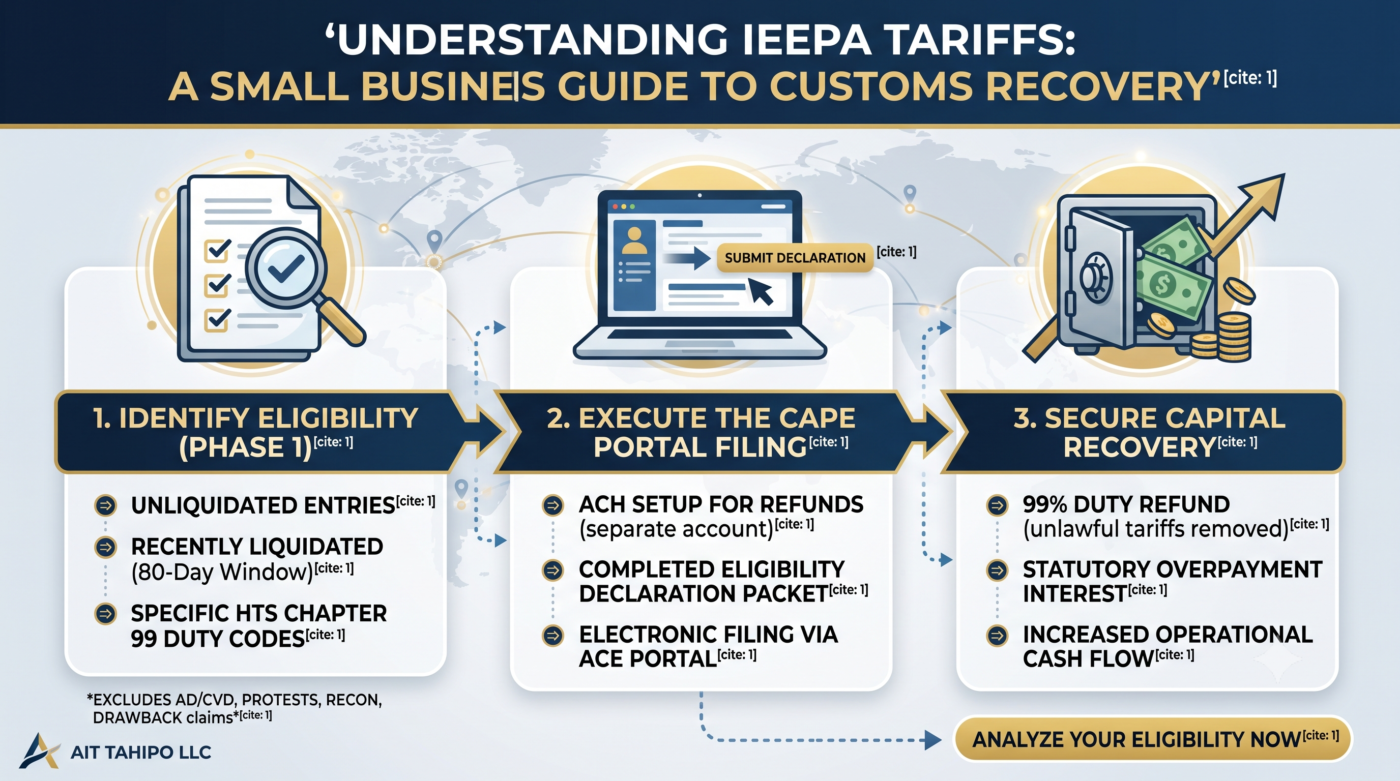
Because processing rules route submissions on a strict first-in, first-out sequence, execution delays present direct financial risks to smaller importers. Moving through the configuration stages requires your firm to address several critical database variables:
- Verification of active Importer of Record parameters inside your company sub-accounts.
- Configuration of separate, refund-specific ACH instructions distinct from standard automated collection accounts.
- Assembling structured data layouts that consolidate thousands of transaction records without entry-level line errors.
Phase 1 Exclusion Parameters
Small businesses should note that entries tied to open protests, reconciliation summarization frameworks, antidumping or countervailing duty orders, or active drawback programs fall entirely outside current Phase 1 processing channels[cite: 1]. Checking entry lines against these specific rules protects data packets from automated system rejections.
Execution Workflows and Asset Capital Verification
Filing a declaration involves creating clear match records across your historic entry summary logs. Each formal filing packet requires explicit matching against targeted Harmonized Tariff Schedule duty codes. For comprehensive guidance regarding baseline entry rules, small businesses can visit our master AIT Tahipo Homepage to map compliance pathways[cite: 1].
When an electronic declaration file routes successfully through automated validation checks, customs teams recalculate initial entry summaries to remove the disputed code structures. This action initiates a reliquidation step where principal cash balances settle. Furthermore, statutory updates require the government to calculate overpayment interest alongside the base amount, creating an added capital recovery stream for the claimant corporation.
Initiate Your Customs Eligibility Audit
Protect your operational margins from aging out of current Phase 1 eligibility boundaries. Our licensed customs brokers perform deep diagnostic screenings across your historic trade logs to confirm compliance values.
Analyze IEEPA Eligibility →Document Control and Post-Refund Vulnerability
Every small business guide must stress accuracy over speed. If a single formatting discrepancy or misclassified HTS line occurs within an active upload document, the customs portal drops the submission, creating prolonged operational delays. Importers should consult the official CBP IEEPA Duty Refunds Resource Page to download structural instructions before filing data packets.
Beyond initial settlement cycles, small businesses should be prepared for potential post-refund audit activity. Maintaining robust electronic logging systems ensures that records are preserved for the minimum five-year lookback retention window required under trade enforcement rules. Working with a dedicated provider simplifies this process, keeping documentation clean and defensible long after the capital reaches your bank account.
Small Business Logistics FAQ
How do I check if my previous imports are eligible for Phase 1?
Your entries must contain matching HTS Chapter 99 emergency codes and be currently unliquidated or liquidated within the preceding 80-day voluntary reliquidation window[cite: 1].
What is the penalty for submitting an error inside a CAPE declaration?
A single validation discrepancy will result in the automated rejection of the entire submission packet, forcing your business to correct line items and restart processing queues[cite: 1].
Are corporate interest rates identical to noncorporate rates?
No. Federal interest provisions state that corporate overpayment calculations yield a 6% per annum rate, while noncorporate filings carry a 7% per annum rate[cite: 1].
How IEEPA Tariffs Do They Impact Supply Chain Margins?
To properly audit historic trade data, small business owners must grasp the technical definition of executive trade remedies. Simply put, when analyzing what are IEEPA tariffs from an operational standpoint, you are looking at specialized customs assessments triggered by presidential declarations under the International Emergency Economic Powers Act.
Unlike standard statutory duties configured by congressional committees, understanding what are IEEPA tariffs requires tracking shifting political and economic criteria that determine border security adjustments. When executive orders cite foreign threats to block commercial actions, CBP deploys unique Chapter 99 duty codes to collect these penalty assessments at the port entry phase.
For decades, small firms operating just-in-time logistics models absorbed these unexpected overhead lines as standard costs of doing business. However, when judicial reviews rule that these administrative border interventions exceeded statutory limits, the legal parameters shifts. This is precisely why knowing what are IEEPA tariffs matters today: it converts an ongoing supply chain expense line into a fully verifiable corporate asset pool, provided your firm maintains clean entry summary archives.
Key Accounting Variables for Emergency IEEPA Tariffs
When quantifying what are IEEPA tariffs on your balance sheets, ensure your compliance team separates baseline ad-valorem duties from secondary overpayment interest components. Because interest tracks all the way back to your initial port entry deposit dates, the final cash collection often totals significantly more than the base principal tariffs paid during initial customs entry clearance cycles.