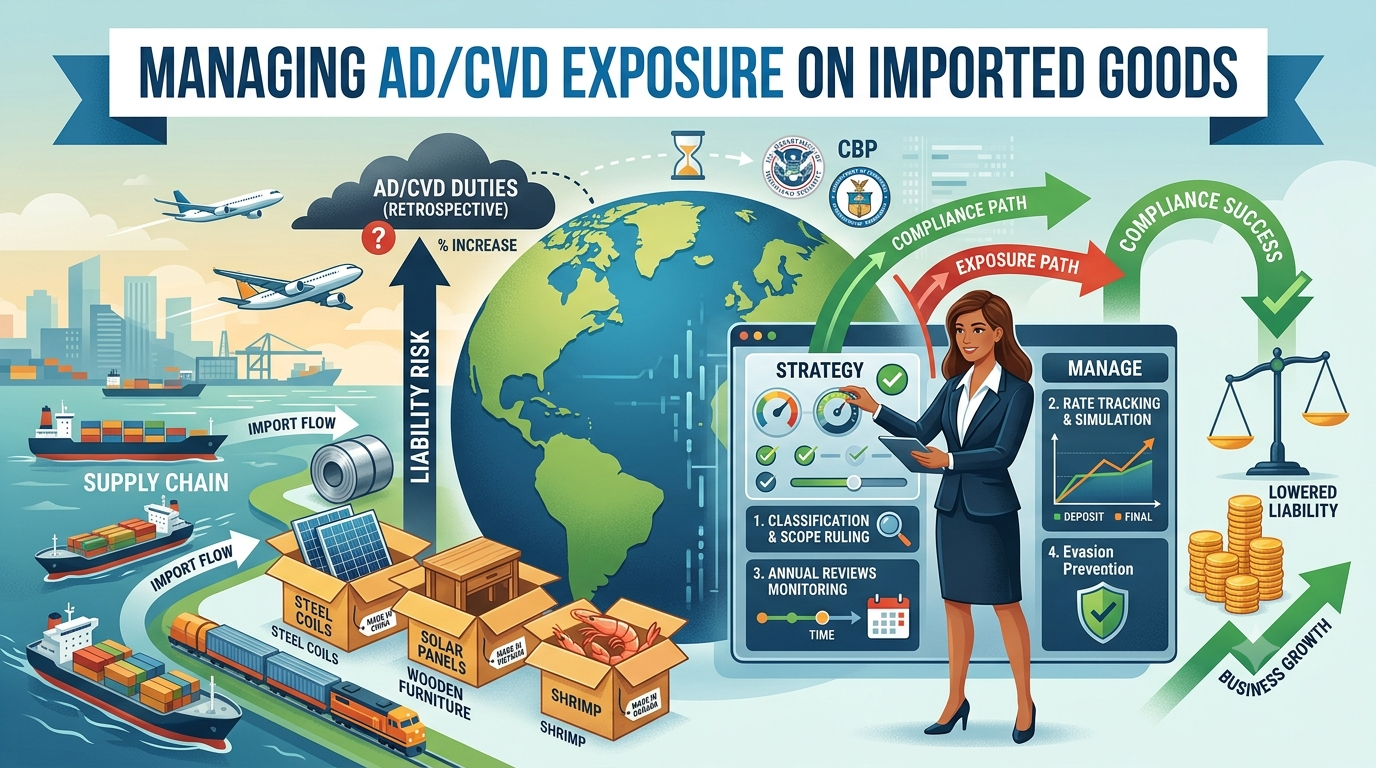
An importer can post a zero percent AD/CVD cash deposit on an entry and still owe six figures eighteen months later, once Commerce finishes reviewing the rate. That gap between what you pay at the border and what you eventually owe is the entire risk profile of antidumping and countervailing duty, and it catches small importers who assume a low deposit means a closed question.
What AD/CVD Actually Charges You For
Antidumping duties apply when a foreign producer sells merchandise in the U.S. below its fair market value. Countervailing duties apply when a foreign government subsidizes the production of goods that then get exported here. Both are calculated by the Department of Commerce and collected by CBP, and both stack on top of whatever standard tariff, Section 301, or other duty already applies to the entry. They aren’t a substitute for regular duty. They’re an addition to it, and depending on the case, that addition can run from a few percent to several hundred percent of the goods’ value.
Why the Cash Deposit You Pay Isn’t the Final Bill
At the time of entry, you post a cash deposit at whatever rate Commerce has last published for your specific exporter, or the country-wide rate if your exporter hasn’t been individually reviewed. That deposit is an estimate, not a settlement. Commerce conducts administrative reviews, typically covering the twelve months ending shortly before the case’s anniversary date, and the review calculates the actual dumping or subsidy margin for that period. The final rate can land above or below what you deposited. If it’s higher, CBP bills you for the difference plus interest, on every entry that fell within the review period, not just the next shipment you bring in. If it’s lower, you get a refund plus interest. Either way, the deposit you paid at entry was never the number that mattered.
A zero percent cash deposit is a common source of false comfort here. It doesn’t mean your product is outside the order. It means the last calculated rate for that exporter happened to be zero. You still have to file the entry with the correct AD/CVD case number, and you’re still exposed if the next review comes back with a different figure.
How to Tell If Your Product Is Covered
Commerce and CBP maintain active case numbers by product and country, searchable through CBP’s Automated Commercial Environment for importers and brokers with ACE accounts. That’s the starting point for checking whether a product line falls under an order, but it’s not always conclusive on its own. Plenty of orders are written around specific technical descriptions, dimensions, or compositions that don’t map cleanly onto a commercial product description. When it’s genuinely unclear whether your merchandise fits inside an order’s scope, the way to get a binding answer is a formal scope ruling request to Commerce’s International Trade Administration. A port import specialist can give informal guidance, but that advice isn’t binding on CBP later.
For the categories AIT TAHIPO’s clients typically move, food, apparel, cosmetics, and electronics, the exposure tends to concentrate in specific commodities and industrial inputs rather than across entire product categories. Long-running orders on garlic, honey, and shrimp catch food importers directly. Electronics and hardware importers are more likely to run into orders covering aluminum extrusions, steel or aluminum components, and certain battery inputs used in assembled goods, even when the finished product itself doesn’t read like a typical AD/CVD target.
Bonding and Entry-Level Exposure
Because the eventual duty bill can run well above the cash deposit, CBP has the authority to require a single transaction bond, or cash in lieu of a continuous bond, whenever it has reasonable grounds to believe a standard continuous bond wouldn’t cover the revenue at risk on AD/CVD-covered entries. That’s a separate calculation from your general continuous bond, and it’s worth checking before you commit to a shipment, not after CBP raises it. See the customs bond calculation guide for how bond sufficiency gets assessed more broadly: https://aittahipo.com/customs-bond-calculation-guide/
Drawback Doesn’t Apply Here
If part of your compliance planning relies on duty drawback to recover costs on goods that get re-exported, it’s worth knowing upfront that AD/CVD duties generally aren’t eligible. They’re treated as remedial measures aimed at offsetting unfair trade practices, not as ordinary revenue duties, so the drawback provisions that apply to standard tariffs don’t extend to them. See drawback processing services for what is recoverable: https://aittahipo.com/drawback-processing-services/
When CBP Suspects Evasion
A separate and more serious exposure shows up when CBP believes an AD/CVD order is being evaded, typically through transshipment, where goods actually produced in a covered country are routed through a third country and declared with a different origin to avoid the duty. CBP investigates these allegations under the Enforce and Protect Act, and a finding of evasion lets CBP suspend liquidation, extend the liquidation period, and demand the evaded duties going back across the entries involved. It can also lead to civil penalties under 19 U.S.C. 1592, separate from the underlying duty bill. If a CF-29 Notice of Action shows up alongside an AD/CVD question, treat it as connected to a broader duty determination, not a standalone paperwork issue. See the CF-29 Notice of Action response guide: https://aittahipo.com/cf-29-notice-of-action-response-guide/
What This Looks Like for a Small Importer
One recurring version of this: an importer bringing in aluminum components for use in an assembled electronics product checks the cash deposit rate, sees it’s low or zero for their named supplier, and treats the AD/CVD question as settled. Eighteen months later, an administrative review comes back with a materially higher margin for that supplier, and CBP issues a bill covering every entry from that review period, not the one shipment currently in transit. Because the company never set aside a reserve against that possibility, the bill lands as an unplanned six-figure liability rather than a manageable cost of doing business. The underlying compliance work, checking the case number, tracking the exporter’s review history, would have flagged the exposure well before the bill arrived.
Managing the Exposure Going Forward
The practical fix isn’t complicated, but it has to run on the same schedule as Commerce’s review cycle, not your shipping schedule. Track the case number and current rate for every exporter you use on covered products, and check for pending administrative reviews before assuming last year’s rate still applies. Build a financial reserve against the gap between your cash deposit and a plausible higher final rate, sized to your actual entry volume in covered categories. Confirm your supply chain’s actual country of production, not just the invoice’s stated origin, since that’s the fact CBP checks first in an evasion allegation. And treat a scope question as something to resolve before the goods ship, not after an entry gets flagged, since a formal scope ruling takes time Commerce doesn’t compress for you.
Frequently Asked Questions
What’s the difference between antidumping and countervailing duties?
Antidumping duties address goods sold in the U.S. below their fair market value. Countervailing duties offset a foreign government subsidy on the exporting producer. They’re calculated through separate investigations and can apply to the same product at the same time.
Why did I pay a 0% cash deposit but still get billed later?
A zero percent deposit reflects the last calculated rate for your specific exporter, not a determination that your product is exempt from the order. If a later administrative review sets a higher rate for that exporter, CBP bills the difference retroactively across the entries the review covers.
How do I know if my product is subject to an AD/CVD order?
Check the active case numbers through CBP’s ACE system for your product and country of origin. If the order’s scope language doesn’t clearly cover or exclude your specific product, request a formal scope ruling from Commerce’s International Trade Administration rather than relying on informal guidance from a port officer.
Can AD/CVD duties be recovered through duty drawback?
Generally no. AD/CVD duties are classified as remedial measures rather than standard revenue duties, so the drawback provisions that apply to ordinary tariffs don’t extend to them.
What is a scope ruling and when do I need one?
It’s a binding determination from Commerce’s International Trade Administration on whether a specific product falls inside or outside an AD/CVD order’s coverage. You need one when the order’s written scope doesn’t map clearly onto your product’s description or composition.
What happens if CBP suspects my goods are evading an AD/CVD order?
CBP can open an investigation under the Enforce and Protect Act, suspend or extend liquidation on the entries involved, and demand the evaded duties. A finding of evasion can also lead to civil penalties separate from the duty itself.
Do I need a special bond for AD/CVD-covered goods?
CBP can require a single transaction bond or cash in place of a continuous bond when it has reason to believe your standard bond wouldn’t cover the potential revenue at risk on AD/CVD entries. It’s worth confirming your bond adequacy before the shipment, not after CBP flags it.
If you’re bringing in goods that touch an active AD/CVD case number, or you’re not sure whether they do, book a free consultation call with AIT TAHIPO LLC.