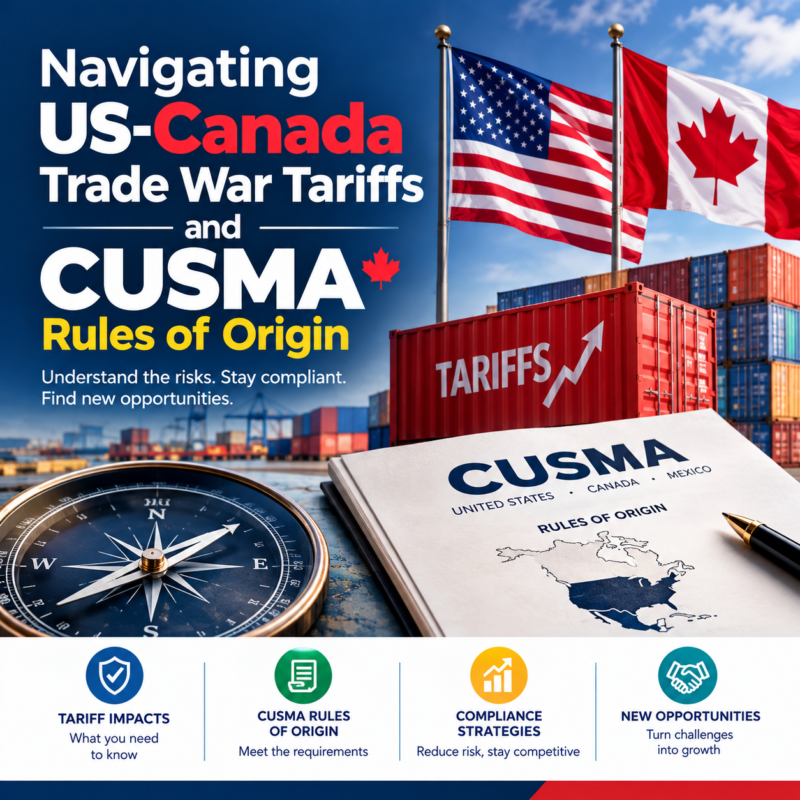
Trade War. Cross-border supply chains face severe structural shifts following retaliatory surcharges, expanded Section 232 duties, and aggressive border enforcement between the United States and Canada. While the Canada-United States-Mexico Agreement (CUSMA) maintains zero-duty treatment for fully qualifying origin merchandise, relying on unverified supply chain records creates immediate financial exposure. Importers face unexpected duty assessments, border detentions, and substantial administrative penalties when failing to document compliance.
Managing entries under current enforcement standards requires aligning trade remedy overlays against verified origin calculations.
Tariff Stacking and CUSMA Protections
Assessing duty exposure requires analyzing how trade remedy surcharges interact with preferential duty status under CUSMA. U.S. importers encounter two primary regulatory risk vectors at the northern border:
- Section 232 Metal and Industrial Tariffs: Section 232 tariffs on steel, aluminum, and copper apply to non-exempt cross-border goods regardless of CUSMA claims. Industrial equipment and raw metal shapes face duty rates ranging from 15% to 50% ad valorem.
- Section 122 and Section 338 Surcharges: Non-CUSMA compliant goods entering the United States from Canada incur mandatory trade remedy surcharges on top of standard Most-Favored-Nation (MFN) rates.
Proving Origin Under CUSMA Rules
To claim duty-free status and avoid baseline surcharges, imported goods must satisfy product-specific rules of origin. Surviving a U.S. Customs and Border Protection (CBP) audit depends on three origin qualification pathways:
- Tariff Shift Criterion: Every non-originating raw material or component imported into Canada from outside North America must undergo a required Harmonized Tariff Schedule (HTS) heading or subheading transformation during manufacturing.
- Regional Value Content (RVC): Industrial products and vehicle components must satisfy specific RVC thresholds—typically calculated at 65% under the Net Cost Method or 75% under the Transaction Value Method.
- De Minimis Standard: Non-originating components that fail a required tariff shift must not account for more than 10% of the total value or weight of the final product.
Importers must maintain detailed supply chain records, including signed producer certificates of origin, bill of materials (BOM) breakdowns, and direct transit documentation, to prove preferential origin during regulatory audits.
Executing a Four-Step CUSMA Origin Audit
Relying on vendor-provided origin certificates without independent technical verification constitutes a failure of reasonable care under 19 U.S.C. 1484. Importers must institute an internal audit process across four operational steps:
- Deconstruct the Bill of Materials: Gather engineering documentation for every component. Isolate inputs originating outside CUSMA territories and verify their 6-digit HTS classifications.
- Apply Product-Specific Rules of Origin: Match the finished good’s 10-digit HTS code against CUSMA Annex 4-B. Confirm whether origin requires a tariff shift, an RVC threshold, or a combination of both.
- Calculate Regional Value Content: Run dual calculations using the Net Cost and Transaction Value methods. Ensure non-originating freight, packaging, and handling costs are properly excluded from originating calculations.
- Build an Audit-Ready Compliance Binder: Store proof of origin records for five years. Binders must include supplier affidavits, mill test reports, production logs, and cost accounting matrices detailing labor and overhead allocations.
Handling CBP Inquiries and Post-Summary Corrections
When CBP targets Canadian imports, it issues CBP Form 28 (Request for Information). Importers typically have 30 days to substantiate origin claims. Failing to respond with complete technical proof results in CBP issuing Form 29 (Notice of Action), which formally denies CUSMA preference, reclassifies the entry, assesses back duties with interest, and opens the importer to penalty proceedings under 19 U.S.C. 1592.
If an internal audit reveals an incorrect CUSMA claim on an unliquidated entry, file a Post Summary Correction (PSC) in the Automated Commercial Environment (ACE) before scheduled liquidation. For liquidated entries, importers must evaluate submitting a formal Prior Disclosure to tender unpaid duties and cap civil penalty exposure.
FAQ
Does a CUSMA Certificate of Origin fully shield Canadian goods from all U.S. tariffs?
No. While CUSMA eliminates standard MFN duties and trade remedy surcharges, Section 232 tariffs on steel, aluminum, and specific derivative items apply regardless of CUSMA qualification.
What happens if an importer claims CUSMA preference without adequate proof?
CBP issues a Form 28 or Form 29, disallows the preference, assesses unpaid base duties and surcharges, and imposes monetary penalties under 19 U.S.C. 1592 for negligence or gross negligence.
Can U.S. importers apply for tariff remissions or exclusions on Canadian imports?
Yes. If specific technical grades or raw material inputs are unavailable from domestic suppliers, importers can file formal exclusion requests through the Department of Commerce or utilize active product-specific remission frameworks.
How long must an importer retain CUSMA compliance records?
Under 19 CFR Part 163, importers must keep all entry summary records, commercial invoices, bills of materials, and origin certifications for five years from the date of entry.
Who is legally responsible for incorrect CUSMA claims?
The Importer of Record listed on CBP Form 7501 bears sole legal responsibility for entry accuracy and duty payments under the Customs Modernization Act.
Book a Free Consultation Call to review your Canadian import entries, audit your CUSMA rules of origin, and restructure your border documentation to minimize tariff exposure.