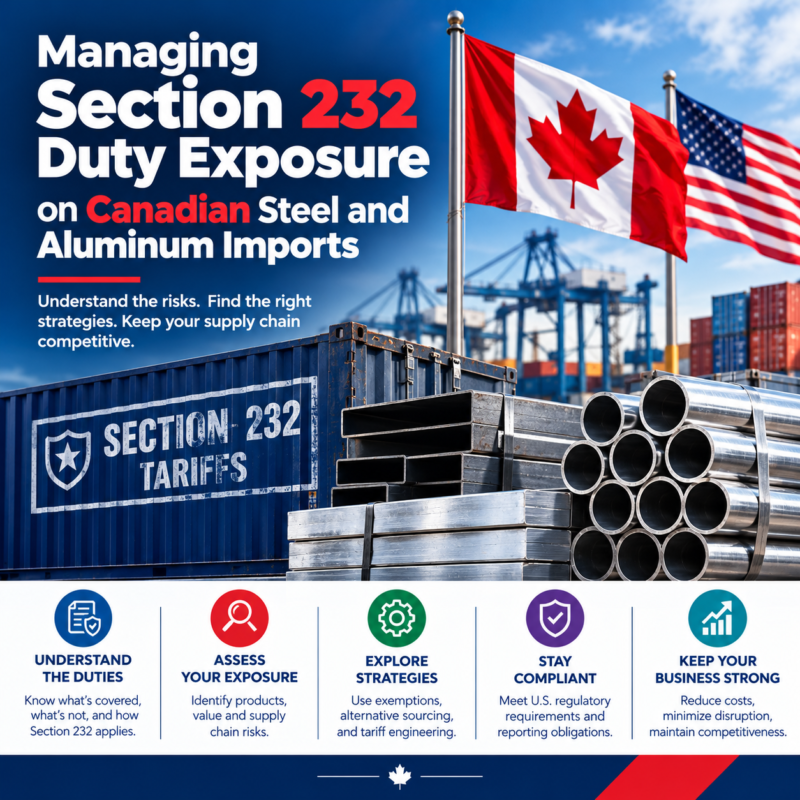
Enforcing Section 232 tariffs on Canadian metals and derivative products remains a primary cost driver for U.S. industrial manufacturers. With rates reaching up to 50% on raw metals and 15% to 25% on derivative components, improper customs declarations create severe balance sheet risks.
Navigating these regulations requires technical classification, tracking Chapter 99 secondary HTS assignments, and applying non-U.S. content rules.
Determining Section 232 Exposure Across Metal Categories
Customs entries involving Canadian metal content require analyzing three regulatory layers:
- Raw Mill and Unwrought Metals: Unwrought aluminum, raw steel, and primary copper shapes entering from Canada incur maximum Section 232 duty assessments.
- Metal Derivatives and Hardware: Fasteners, structural shapes, tubing, and wire products made from Canadian metal face Section 232 rates based on metal content and entry classification.
- Industrial Machinery and Equipment: Mobile industrial equipment and specific machinery qualify for partial duty calculations, where applicable rates apply exclusively to non-U.S. content, subject to minimum ad valorem floors.
Step-by-Step Tariff Management Framework
- Map Your 10-Digit HTS Numbers: Audit every product SKU to confirm whether primary Chapter 72, 73, or 76 HTS numbers trigger secondary Chapter 99 tariff overlays in ACE.
- Isolate U.S.-Origin Content: For goods manufactured in Canada using U.S.-origin metal, compile mill test certificates and export documentation. Products containing high levels of verified U.S.-origin metal content qualify for reduced effective duty calculations.
- Verify Valuation Methods: Ensure declared customs values reflect actual transaction values under 19 U.S.C. 1401a, isolating non-dutiable international freight, insurance, and inland transportation fees.
- Maintain Sub-Assembly Tracing: Keep detailed mill certificates, country of melt and pour records, and processing logs on file for five years to satisfy CBP verification checks.
Country of Melt and Pour Requirements
CBP mandates strict reporting for all steel imports. Importers must report the original country of melt and pour on every steel entry summary. Processing raw steel in Canada does not confer Canadian origin for Section 232 purposes unless the material undergoes a substantial transformation under applicable customs laws.
If foreign billet or slab is poured in a third country, imported into Canada for basic rolling, and shipped to the United States, CBP assesses Section 232 duties based on the primary country of origin where the steel was melted. Failing to report the true country of melt and pour leads to entry rejections, delayed clearance, and civil penalty investigations under 19 U.S.C. 1592.
Leveraging Section 232 Exclusion Requests
U.S. importers facing high Section 232 duties can apply for product-specific exclusions through the Department of Commerce’s Section 232 Exclusion Portal. Exclusions are granted if the specific product grade, dimensions, or technical specifications are not produced in the United States in sufficient and reasonably available quantities.
An approved exclusion allows the importer to enter specific HTS codes under secondary Chapter 99 headings free of Section 232 duties. Exclusions apply retroactively to the date the request was officially posted for public comment, enabling importers to recover duties paid on unliquidated entries via Post Summary Corrections.
FAQ
Does the country of melt and pour matter for Canadian steel entries?
Yes. CBP requires importers to declare the original country of melt and pour for steel imports. Processing steel in Canada does not change its origin for Section 232 purposes unless a substantial transformation occurs under specific tariff regulations.
Are auto parts exempt from Section 232 metal tariffs?
Certain passenger vehicle parts imported under CUSMA retain specific carve-outs, but heavy truck, agricultural, and specialized trailer components face derivative metal tariffs.
How are Section 232 duties reported in ACE?
Customs brokers must declare both the primary 10-digit HTS code for the product and the applicable secondary 9903 tariff heading on CBP Form 7501.
What is the penalty for misreporting country of origin on metal imports?
Misreporting country of origin to evade Section 232 duties constitutes a violation of 19 U.S.C. 1592, subjecting importers to penalties up to the domestic value of the merchandise.
Can Section 232 duties be recovered via Duty Drawback?
Unused or manufacturing Duty Drawback applies to specific secondary tariff overlays, provided complete import and re-export tracing records are maintained.
Book a Free Consultation Call to audit your metal imports, analyze country-of-origin melt data, and file accurate ACE corrections to protect your business from tariff penalties.