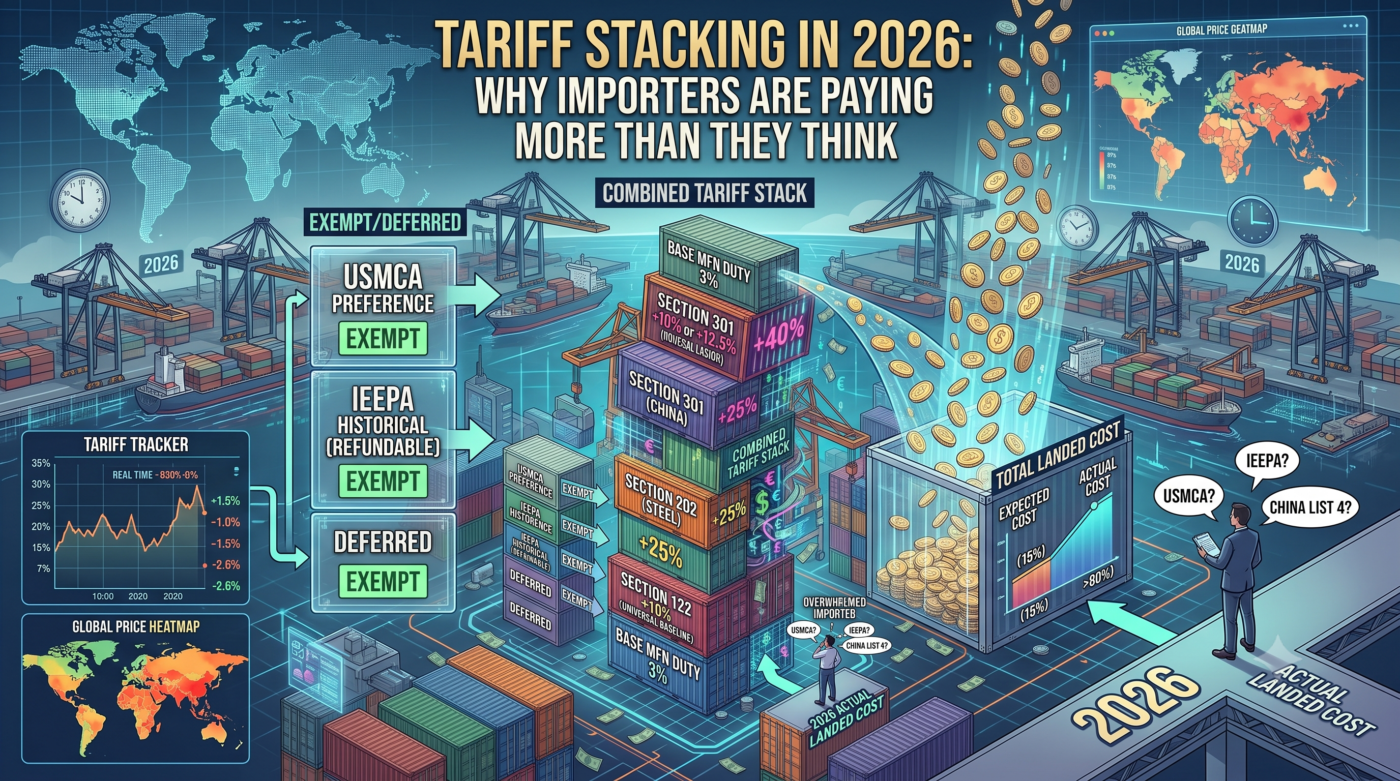
Tariff stacking 2026. A housewares importer priced a shipment of steel cookware out of China using the numbers from her last order, six months earlier. She landed the container and found her duty bill nearly double what she’d budgeted. Nothing about the product had changed. What changed was that a Section 232 derivative tariff had been added to her HTS code in the interim, stacking on top of the Section 301 duty she was already paying, on top of the base MFN rate that had always applied. She wasn’t looking at one tariff anymore. She was looking at three, compounding on the same shipment.
That’s what stacking means in practice, and it’s the single biggest reason landed cost estimates built even a few months ago are running low. A product doesn’t get one tariff assigned to it based on where it’s from. It can carry a base MFN duty, a Section 301 surcharge if it’s from China, a Section 232 tariff if it touches steel, aluminum, copper, or a handful of other sectors, an antidumping or countervailing duty if Commerce has an active order on that specific product, and the standard processing fees on top of all of it. Each layer gets calculated independently and added, not averaged or capped, unless a specific anti-stacking rule says otherwise.
The layers, and where they don’t stack
Section 301 tariffs apply to Chinese-origin goods across several lists, with rates still running as high as 25% on many categories and effective combined rates exceeding 100% once every applicable layer lands on a single product. Section 232 covers steel, aluminum, copper, and their derivative products at up to 50%, along with sector-specific tariffs on autos and semiconductors. Products can carry both Section 301 and Section 232 exposure at once if they’re Chinese-origin steel derivatives, for instance, since those two programs generally don’t cancel each other out.
Where the anti-stacking rules actually kick in is around Section 122, the universal surcharge that ran at 10%, then 15%, from February 24 through July 24, 2026, when it expired under its own 150-day statutory cap. Section 232-covered goods were exempt from Section 122 the entire time it existed, and USMCA-qualifying goods from Canada and Mexico never paid it either. The day Section 122 lapsed, a new Section 301 tariff tied to forced-labor enforcement findings took effect on goods from roughly sixty trading partners, layering a 10 to 12.5% duty on top of whatever those countries were already paying. For importers from those sixty countries, the surcharge didn’t disappear. It just changed its legal name and its rate.
Antidumping and countervailing duties add another layer entirely, assessed per producer and independent of everything above, and merchandise processing fees apply on top of all of it regardless of what else is stacking. The elimination of the de minimis exemption in February 2026 compounded the effect further, since every shipment now requires formal entry and full duty calculation, including the low-value parcels that used to clear automatically.
Why this is costing importers money right now
Most landed cost models were built assuming one or two tariff variables. The 2026 environment routinely runs four or five on a single HTS code, and the rates on any given layer can change with weeks of notice, not the annual cycle importers are used to planning around. A pricing sheet from March is not a reliable guide to a shipment landing in August. Getting the classification right at the product research stage, before goods are ordered, is the cheapest point in the process to catch a stacking exposure you didn’t know you had.
Frequently Asked Questions
What does tariff stacking mean? It means more than one tariff program applies to the same product at the same time, with each layer calculated independently and added to the total duty owed.
Do all tariffs stack with each other? No. Some programs have explicit anti-stacking rules. Section 232-covered goods are exempt from Section 122, and USMCA-qualifying goods are exempt from both Section 122 and the earlier IEEPA tariffs.
Is Section 122 still in effect? It expired on July 24, 2026, 150 days after it took effect, under the statutory limit that governs how long that authority can run without Congressional action.
What replaced Section 122 after it expired? A new Section 301 tariff tied to forced-labor enforcement took effect the same day for around sixty trading partners, at rates of 10 to 12.5%.
How do I find out how many tariff layers apply to my product? It requires a full classification and country-of-origin review against current Section 301, Section 232, and AD/CVD orders, since the combination is specific to both the HTS code and the country of manufacture.
If your landed cost numbers haven’t been checked against the current tariff stack, you’re probably budgeting against a rate that no longer applies. Book a Free Consultation Call with AIT TAHIPO LLC and we’ll run your product list against everything currently in effect.