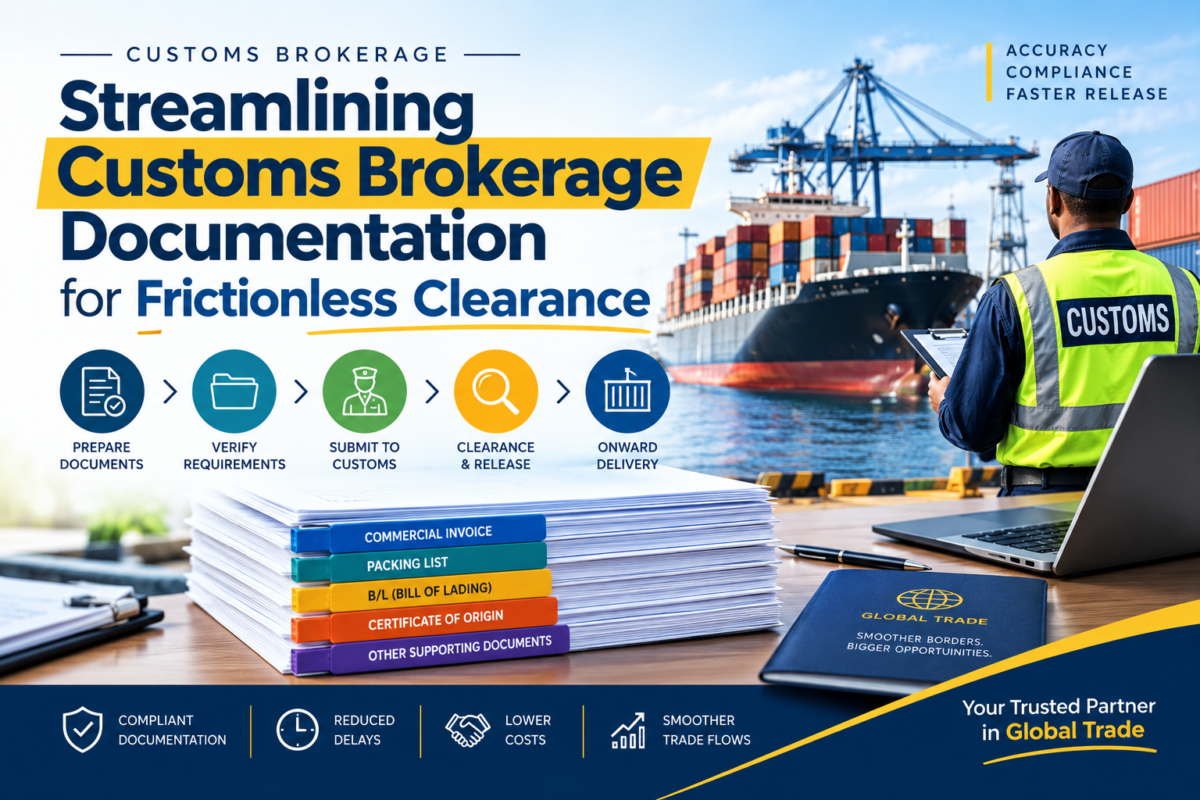
Every commercial shipment crossing into the United States requires comprehensive customs brokerage documentation to substantiate its legal admissibility, product classification, and valuation. U.S. Customs and Border Protection operates under an informed compliance model established by the Customs Modernization Act. This framework places the legal burden directly on the Importer of Record to exercise “reasonable care” in all declared details.
Incomplete commercial paperwork or discrepancies across logistics records trigger automated targeting holds in the Automated Commercial Environment (ACE). These documentation errors lead to physical cargo inspections, prolonged border holds, and civil monetary penalties under 19 U.S.C. § 1592.
Regulatory Pitfalls in Trade Documentation
Preparing entry paperwork requires avoiding three frequent compliance gaps:
Commercial Invoice Ambiguity and Inadequate Item Descriptions: CBP rejects generalized product terms such as “auto parts,” “samples,” or “electronics”. Invoices must present clear commercial descriptions, exact material compositions, intended end-use, and clear itemization of prices paid or payable.
Inconsistent Incoterms and Dutiable Value Omissions: Inaccurate use of Incoterms confuses freight deductions and dutiable additions. Omissions of dutiable assists such as buyer-provided tooling, foreign design work, engineering costs, or ocean freight packing result in unlawful undervaluation.
Partner Government Agency (PGA) Data Mismatches: Regulated commodities require specialized agency filings alongside customs declarations. Inconsistencies between FDA product codes, EPA declarations, or USDA Lacey Act forms and the underlying customs invoice cause clearance stops.
Four Core Steps to Manage Customs Clearance Paperwork
1. Execute an Auditable Customs Power of Attorney (POA): Provide your licensed customs broker with a valid CBP Form 5297 Power of Attorney executed by an authorized corporate officer. Under 19 C.F.R. § 111.36, brokers must establish the verified identity of the importer through corporate records and government IDs before filing entries on their behalf.
2. Standardize Commercial Invoices and Packing Lists: Ensure overseas vendors produce commercial invoices compliant with 19 C.F.R. § 141.86. Invoices must specify detailed line-item descriptions, 10-digit HTSUS classification codes, unit values, currency of sale, country of origin, and complete buyer/seller corporate identities. Pair this with a packing list breaking down gross and net weights, piece counts, and individual container loading manifests.
3. Transmit the Ocean Importer Security Filing (ISF 10+2): For maritime cargo, submit the 10 critical supply chain data elements to your customs broker at least 24 hours prior to container lading at the foreign departure port. Late, inaccurate, or missing ISF transmissions result in automated $5,000 liquidated damages penalties per violation directly from CBP.
4. Review CBP Form 7501 Entry Summaries Before Liquidation: Audit the entry packet generated by your broker, specifically checking the declared customs value, duty calculations, and partner government agency disclaimers. Retain this entire document packet for a minimum of five years from the entry date under 19 C.F.R. Part 163 recordkeeping mandates.
CBP Recordkeeping Mandates and the (a)(1)(A) List
Customs compliance does not end when cargo clears the gate. Under 19 U.S.C. § 1508 and 19 C.F.R. Part 163, importers must preserve every document defined in the statutory “(a)(1)(A) list” for five years from the date of entry summary filing. This includes purchase orders, commercial invoices, proof of payment, bills of lading, and manufacturing certificates.
If CBP conducts a focused assessment or issues a formal Form 28 Request for Information, failure to produce records within the mandated timeframe exposes your business to recordkeeping penalties up to $100,000 per release. Establishing central electronic document storage guarantees rapid retrieval and audit readiness.
Frequently Asked Questions
What core documents are mandatory for clearing standard U.S. customs entries?
A standard entry packet requires a Customs Power of Attorney, Commercial Invoice, Packing List, Bill of Lading or Air Waybill, and CBP Form 7501 Entry Summary.
Who is legally responsible for documentation inaccuracies—the broker or the importer?
Under 19 U.S.C. § 1484 reasonable care standards, legal responsibility rests with the Importer of Record. Brokers file data based on instructions provided by the importer, who remains liable for duty underpayments and documentation errors.
What is the penalty for filing an Importer Security Filing (ISF) late?
CBP issues liquidated damages assessments of $5,000 per late, inaccurate, or incomplete ISF transmission, up to a maximum of $10,000 per shipment.
How long must import documentation be preserved under U.S. law?
Importers must maintain all records related to commercial importations for five years from the date of entry summary filing under 19 C.F.R. Part 163.
What is the difference between a pro forma invoice and a commercial invoice?
A pro forma invoice is a provisional price quote used prior to final transaction execution. CBP requires a definitive commercial invoice detailing the actual price paid or payable and full product descriptions for formal clearance.
Book a Free Consultation Call to review your import documentation protocols, ensure PGA reporting accuracy, and protect your supply chain against costly border delays.