Duty drawback. Importing merchandise into the United States requires substantial working capital dedicated to customs duties, trade remedy tariffs, and processing fees. When those imported goods or commercially interchangeable substitutes are subsequently exported or destroyed under customs supervision, companies can recover up to 99% of those expenditures under 19 U.S.C. § 1313 and 19 C.F.R. Part 190.
Despite statutory authorization, millions of dollars in eligible duty refunds go unclaimed annually. Modern drawback under the Trade Facilitation and Trade Enforcement Act (TFTEA) liberalized substitution standards based on 8-digit HTS classifications. However, it also introduced stringent digital data validation standards that trigger automated rejections if entry and export records do not align precisely.
Critical Compliance Foundations in Drawback Operations
Managing trade remedy exposure and drawback claims requires tracking three primary operational risk zones:
Statutory Timelines and the Five-Year Rule: Under TFTEA provisions, claimants have exactly five years from the date of merchandise importation to complete all qualifying exportations and transmit an electronic drawback claim to CBP. Claims filed outside this statutory window are barred without exception.
Direct Identification vs. Substitution Accounting: Businesses can establish qualification via direct inventory serial tracking under 19 U.S.C. § 1313(j)(1) or through substitution under § 1313(j)(2) using identical 8-digit HTSUS subheadings. Substitution simplifies tracking, but requires proof that exported goods share the exact tariff classification and commercial standard as imported lines.
Valuation Caps and Apportionment: Drawback calculations under modern rules apply the “lesser of” rule for substitution claims. Claimants receive 99% of duties paid on the imported merchandise, or 99% of the duties that would have applied to the exported article had it been imported, whichever calculation is lower.
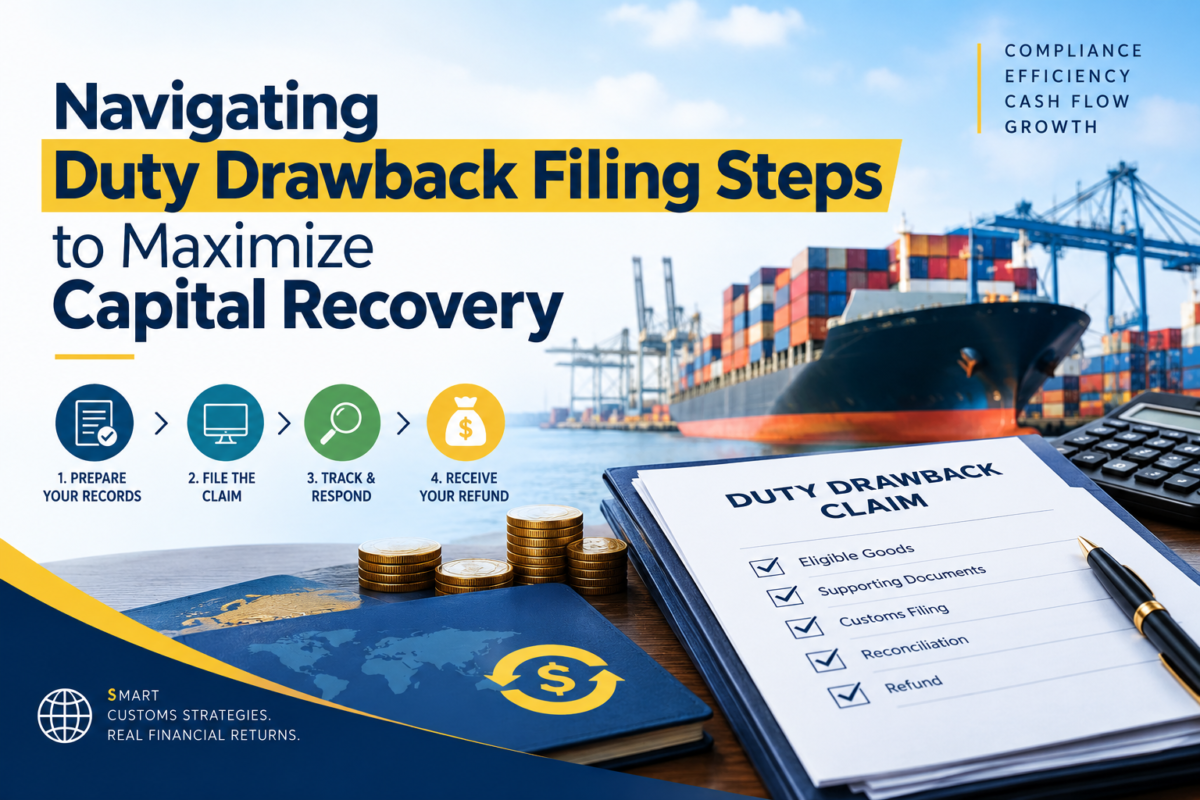
Four-Step Protocol to File Compliant Duty Drawback Claims
1. Aggregate and Validate Entry Data: Extract CBP Form 7501 Entry Summaries, commercial invoices, and proof of duty payments directly from your Automated Commercial Environment (ACE) portal account. Verify that baseline customs duties, Section 301 tariffs, and Merchandise Processing Fees (MPF) were fully deposited and unliquidated or within applicable filing periods. Confirm that entry documents demonstrate proper Importer of Record designation.
2. Establish Traceable Exportation or Destruction Records: Assemble cross-border transport proof, including export bills of lading, Electronic Export Information (EEI) filing records in the Automated Export System (AES), and foreign customs clearance documentation. If claiming drawback on destroyed inventory, ensure CBP Form 7553 was filed at least five working days prior to physical destruction so customs officers had opportunity to supervise the process.
3. Submit Accelerated Payment Applications and Bonds: Standard drawback liquidation takes one to three years to yield a refund check. Apply for Accelerated Payment privileges under 19 C.F.R. § 190.92 and secure a continuous drawback bond. Accelerated status authorizes CBP to disburse duty refund payments within 30 to 60 days of claim transmission.
4. Transmit Electronic Drawback Summaries to the Appropriate CEE: Transmit electronic claim datasets via EDI using CBP Form 7551. Route the filing to your assigned Center of Excellence and Expertise (CEE) team code matching your industry sector. Reconcile any automated error notifications within ACE immediately to prevent claim rejection.
Enforcement Realities and Accelerated Payment Risks
Accelerated payment allows quick receipt of working capital, but it does not represent final CBP approval. Claims remain open until formal liquidation. If a subsequent CBP desk review or on-site audit uncovers unsubstantiated export links, duplicate duty matches, or incorrect HTS substitutions, the agency issues a formal demand for repayment. Claimants must return the disbursed refund along with accumulated statutory interest. Maintaining unbroken digital audit trails prevents sudden clawbacks and customs penalties.
Frequently Asked Questions
Can trade remedy tariffs like Section 301 duties be claimed for drawback?
Yes. Section 301 duties paid on Chinese-origin products are eligible for duty drawback upon subsequent export. However, Section 232 steel and aluminum duties are statutorily barred from drawback recovery.
What is the time limit for filing a duty drawback claim?
All drawback claims under 19 C.F.R. Part 190 must be filed within five years from the original date of importation of the merchandise.
Do I have to export the exact same item that was imported?
No. Under TFTEA substitution drawback rules, you may export substitute goods that share the same 8-digit HTSUS subheading as the imported merchandise, provided they meet commercial standards.
How much duty can an importer recover through drawback?
Importers can recover up to 99% of eligible customs duties, internal revenue taxes, and standard fees paid upon entry. CBP retains 1% to cover administrative handling costs.
What occurs if CBP audits an accelerated drawback payment and finds discrepancies?
CBP will issue a Notice of Penalty or Demand for Redelivery. The claimant must return the overpaid funds with statutory interest, and the surety holding the drawback bond remains liable if the importer fails to pay.
Book a Free Consultation Call to audit your historical import entries, identify untapped duty recovery opportunities, and establish an automated drawback filing program.