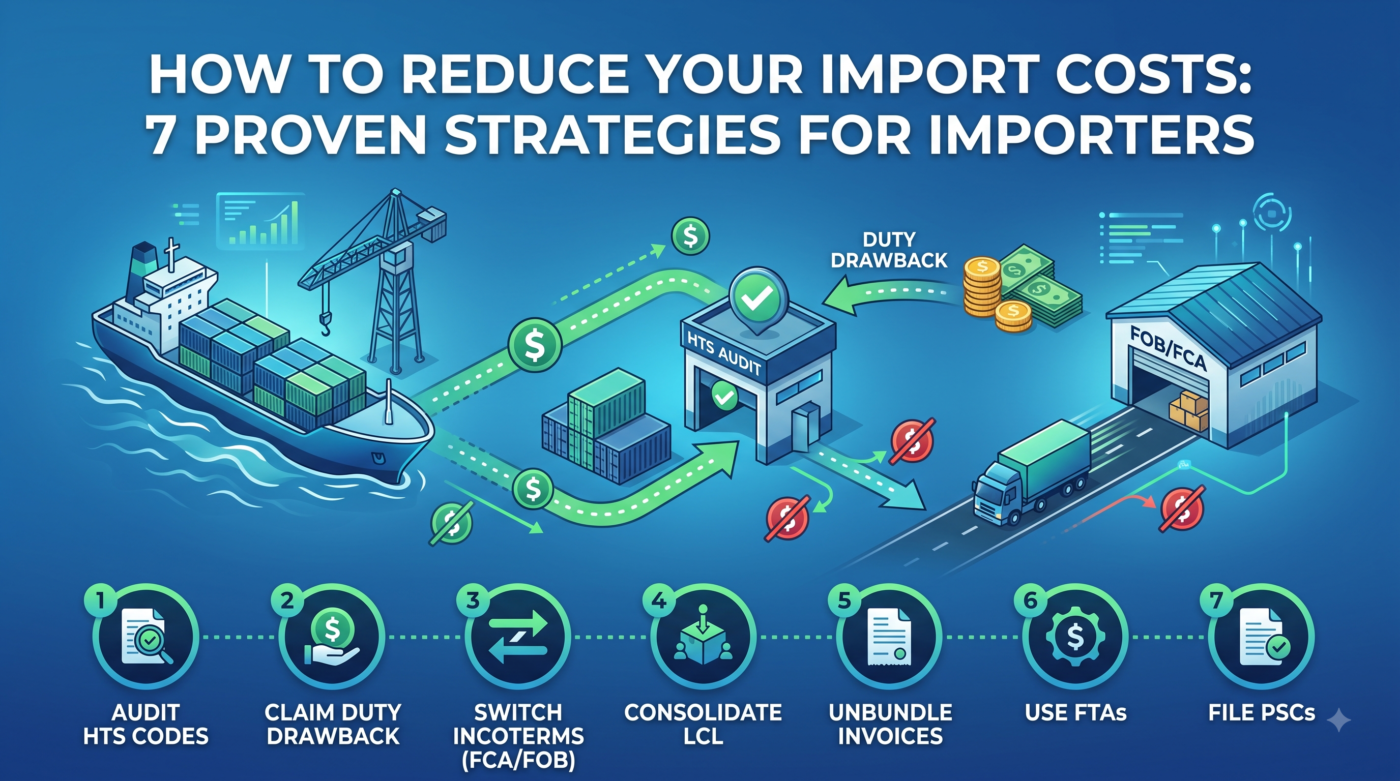
Import Costs. Managing international trade margins requires constant scrutiny of operational overhead, freight rates, and customs liabilities. Importers often accept baseline transit costs and duty calculations without realizing that systematic adjustments can unlock significant capital recovery. By optimizing supply chain mechanics, auditing tariff classifications, and taking advantage of statutory customs programs, businesses can lower landed costs without sacrificing inventory delivery speeds.
Below are seven proven strategies to cut import expenses and keep working capital inside your enterprise.
1. Audit HTS Classifications and Secure Binding Rulings
A single digit discrepancy in a tariff code can artificially double your duty liability. Misclassified goods trigger inflated duty rates or unexpected penalties during U.S. Customs and Border Protection (CBP) audits. Importers often accept generic ten-digit Harmonized Tariff Schedule (HTS) codes provided by overseas suppliers without verifying whether a specific subheading or legal note lowers the duty rate.
Reviewing your product line against legal notes and General Rules of Interpretation (GRI) in the HTSUS often reveals valid alternative classifications that carry lower baseline rates. When product descriptions are ambiguous, requesting a Binding Ruling (CBP Form 177) from U.S. Customs locks in an official duty rate, eliminating retroactive duty assessments during post-entry audits.
2. Reclaim Duty Through U.S. Customs Drawback Programs. Import Costs.
Importers re-exporting merchandise or using imported components to manufacture goods for export do not need to absorb those duty expenses. Under U.S. drawback regulations (19 U.S.C. § 1313), businesses can recover up to 99% of customs duties, taxes, and fees paid on imported merchandise upon export or destruction.
CBP permits a five-year lookback period from the date of importation for unused merchandise and manufacturing drawback claims. If imported shipments arrive damaged or non-conforming, filing rejected merchandise drawback allows you to recover duties when returning or destroying the inventory under CBP supervision.
- Switch Incoterms to FCA or FOB
Buying under Ex Works (EXW) or Delivered Duty Paid (DDP) surrenders financial oversight to the seller, who frequently marks up inland transit, handling, and customs clearance charges. Transitioning to Free Carrier (FCA) or Free On Board (FOB) gives you control over carrier selection, contract freight rates, and customs broker selection.
Direct oversight over ocean and air logistics prevents hidden destination handling surcharges and lets you negotiate volume discounts directly with shipping lines.
- Consolidate LCL Orders into FCL Shipments
Shipping multiple Less-than-Container Load (LCL) orders from separate suppliers generates duplicate origin handling fees, terminal charges, and customs entry processing fees. Setting up a buyer’s consolidation program allows an overseas warehouse to receive goods from multiple vendors and pack them into a single Full-Container Load (FCL) container.
Consolidating orders reduces total ocean freight rates per cubic meter, eliminates redundant entry filing fees, and speeds up port discharge times at destination terminals.
- Unbundle Non-Dutiable Invoice Costs
Customs duties are calculated based on the net price paid or payable for merchandise, but commercial invoices frequently combine international logistics fees into a single figure. Separating non-dutiable charges onto distinct line items on the commercial invoice lowers the entered customs value.
- International Freight: Deduct ocean or air transit costs occurring outside the domestic border.
- Marine Insurance: Exclude transit insurance coverage costs from the primary merchandise value.
- Buying Commissions: Separate legitimate purchasing agent fees from the dutiable product total.
- Post-Importation Assembly: Remove domestic setup or construction fees from the entered value.
Deducting non-dutiable costs keeps your import valuation accurate so you avoid paying percentage tariffs on logistics services.
- Claim Free Trade Agreement Tariff Preferences
Failing to claim preferential tariff treatment under trade agreements like USMCA, CAFTA-DR, or KORUS forces importers to pay standard Most-Favored-Nation (MFN) duty rates. Obtaining specific Rules of Origin documentation and valid Certificates of Origin from suppliers verifies that merchandise meets regional value content criteria.
Validating origin criteria before cargo leaves origin ports unlocks zero-duty or reduced-duty entry status legally.
- File Post-Summary Corrections and Use Accelerated Payment
When entry summaries contain valuation errors or overpaid duties, filing a Post-Summary Correction (PSC) in the Automated Commercial Environment (ACE) adjusts the entry before final liquidation. This allows importers to rectify errors and claim overpayment credits directly from CBP.
For regular drawback claimants, applying for Accelerated Payment (AP) privilege with CBP shortens duty refund turnaround times from years down to 30 to 45 days. Rapid refund turnarounds keep working capital inside your business rather than held in government accounts.
Frequently Asked Questions
How far back can a company claim duty drawback in the U.S.? Under U.S. Customs regulations (19 U.S.C. § 1313), businesses have a five-year statutory lookback window from the date of importation to file duty drawback claims and recover up to 99% of paid duties, taxes, and fees.
What is the difference between EXW and FOB/FCA terms for import costs? Buying EXW surrenders logistics control and allows suppliers to mark up inland transit and handling. Switching to FOB or FCA gives importers direct control over carrier selection, routing, and freight rates.
How does unbundling commercial invoice costs lower customs duty? Customs duties are calculated on the net price of merchandise. Separating international freight, insurance, and post-import assembly from the invoice value reduces the dutiable entered value, saving money on percentage-based tariffs.
Stop leaving money on the table or risking expensive compliance penalties. Book a Free Consultation Call with AIT TAHIPO LLC to audit your HTS codes, review your commercial invoices, and identify untapped duty drawback opportunities.